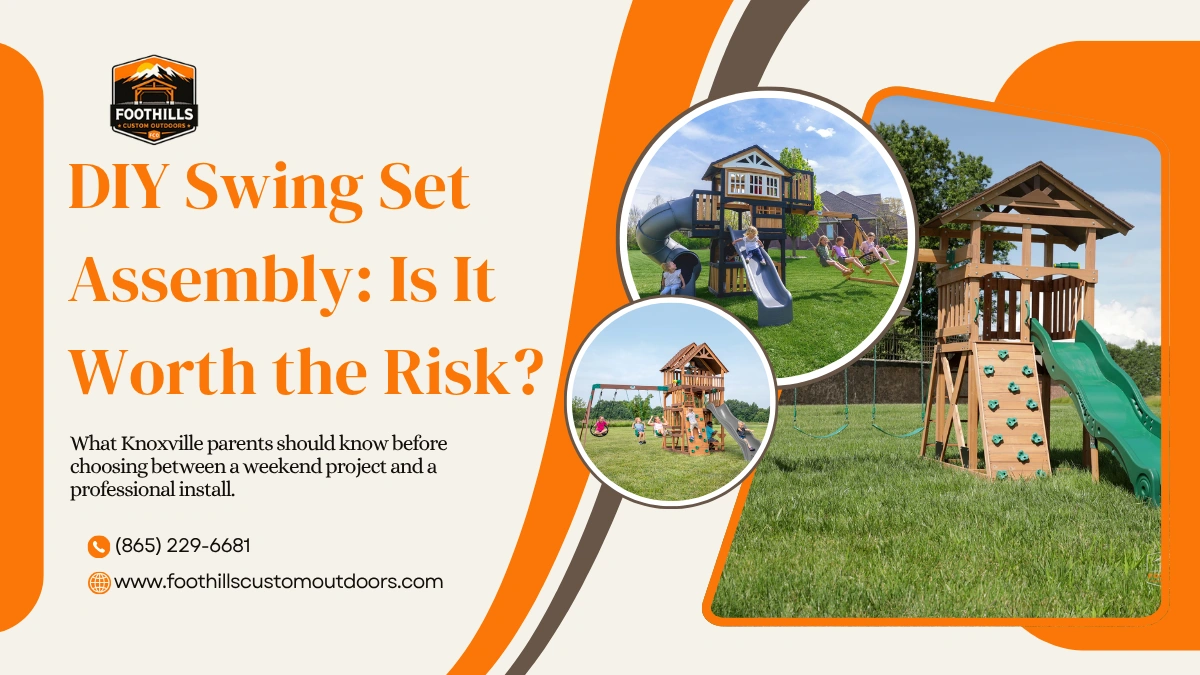
Is DIY Swing Set Assembly Worth the Risk? What Knoxville Parents Should Know
The playset arrives in three enormous boxes, a hardware bag with 400 pieces, and a manual that runs 60 pages. Your spouse looks at you. Your kids ask when they can play on it. And somewhere in the back of your mind, the same question every Knoxville parent asks starts to form: how hard can this really be? This guide is the honest answer, from a full-service outdoor builder that spends real weekends fixing DIY swing sets that didn’t go the way homeowners hoped. We’ll walk through where DIY assembly saves money, where it costs it, where the real safety risks live, and how a professional playset assembly service compares once you look at all the numbers side by side.
Most families who go DIY do so for one honest reason: cost. And the savings are real, at least on paper. But when you factor in tool purchases, weekend hours, structural mistakes, warranty risk, and the very real chance of a set that isn’t quite level, isn’t quite anchored, and isn’t quite safe, the calculation shifts. The right answer isn’t universal – it depends on the set, your yard, your skill level, and what your Saturdays are worth. This piece walks through all of it so you can decide.
The Short Answer: Where DIY Works and Where It Doesn’t
For a small metal A-frame swing set on flat, compact soil, DIY assembly is a reasonable Saturday project for a handy homeowner with basic tools. For a mid-size wooden playset with a fort, slide, and multiple swings, DIY becomes a full weekend of hard work with real risk of assembly errors. For a large multi-deck wooden system with monkey bars, rock walls, or extended features, DIY is a project most families regret starting.
The honest math looks like this. On a $1,200 basic metal swing set, a family can save $200 to $400 doing it themselves. On a $2,500 mid-size wooden set, they can save $400 to $700. On a $5,000 large wooden playset, they can save $700 to $1,200 – but that’s the same category of set where DIY assembly most often leads to hidden safety issues that don’t show up until months later. The bigger the set, the smaller the DIY savings relative to what can go wrong.
Why DIY Playsets Look Cheaper Than They Actually Are
The sticker on the box is not the total cost of building it yourself. Here’s what almost always gets missed when families compare DIY to a professional playset installation service.
Tools you don’t already have: A basic playset assembly needs a power drill, an impact driver, a socket wrench set, a 4-foot level, a tape measure, a rubber mallet, and a ladder. If you have all of them, no cost. If you don’t, expect to spend $250 to $500 stocking up. For larger sets, you’ll also want a post hole digger or auger rental ($30 to $150 per day) for anchoring.
Weekend hours: A basic swing set kit takes two average adults 8 to 16 hours of active work. A mid-size playset takes 20 to 40 hours. A large multi-deck system can eat 40 to 60 hours across multiple weekends. If you value your weekend at even $25 per hour, a 30-hour build has an honest labor cost of $750 that never shows up in the “DIY savings” calculation.
The second person: Almost every step of a playset build requires two adults, and the roof or upper deck steps often require three. If you’re paying friends in beer and pizza, that’s still real cost, and it’s asking for a favor you can’t easily return.
Materials for mistakes: Kits ship exactly the hardware you need. When you strip a screw, drop a bolt in the grass, or realize you drilled through the wrong beam, you’ll need replacements. Most DIY builds burn through $30 to $100 in extra hardware from a Knoxville-area hardware store before the project is done.
Site prep: Manufacturers assume you’re installing on level, prepared ground. Most East Tennessee yards aren’t level. Grading a moderate slope for a playset pad costs $400 to $1,200 if you hire it out, or a weekend of shovel work if you don’t.
Fall surfacing: Every safe playset needs impact-absorbing surfacing under it. This is not optional and it’s not cheap. A 12×14 fall zone filled to a 6-inch depth with quality engineered wood fiber costs $250 to $450 in material; rubber mulch runs $600 to $1,100. Neither number is in the sticker price of the kit.
Assembly mistakes that don’t get fixed: This is the invisible cost. A slightly out-of-square frame stresses joints for years. A hardware substitution using the wrong bolt from Lowe’s changes the load rating. An anchor set at 12 inches instead of 24 inches works fine until a summer storm. These are the errors that lead to injuries, and they’re the errors professional installers see over and over in DIY sets they get called to fix.
When we add all of that up on a mid-size wooden playset, a “DIY” install that theoretically saves $600 in labor typically costs $400 to $900 in tools, extras, and site prep the family didn’t budget for. The net savings is often close to zero, and the family gave up two weekends to get there.
Where DIY Playset Assembly Goes Wrong
Not every DIY build fails. Plenty of Knoxville families put together a metal A-frame swing set in a Saturday afternoon and enjoy it for years. The issues concentrate around specific mistakes, and they concentrate on wooden playsets more than on metal ones.
Skipping the pre-sort: The instructions all say the same thing: lay out every piece of hardware and lumber in the order it appears in the manual before you touch a wrench. Nobody does this on a Saturday morning with excited kids watching. What follows is 20 hours of hunting for the right bolt while the pile shrinks and grows in the wrong directions.
Hardware substitution: When a bolt is missing or a screw is stripped, the temptation is to walk to the hardware store and grab a “close enough” replacement. Swing set hardware is engineered for specific load ratings. A residential swing hanger is rated for 250 to 300 pounds. A standard eye bolt from a hardware store is not. This substitution has caused real injuries in real Knoxville backyards.
Over-tightening bolts into wood: Cordless drills apply more torque than most homeowners realize. Over-tightening crushes wood fibers around the bolt, creating a weak spot exactly where the structure needs strength. The set feels solid on day one and slowly loosens over the next 90 days.
Ignoring squaring during assembly: The A-frame legs and top beams have to be perfectly square before the first anchor goes in. A frame that’s 1 inch off square puts uneven stress on every joint for the life of the set. Most DIY builds don’t check square with a carpenter’s square at every step, and the drift compounds.
Anchoring at the wrong depth or not at all: Manufacturers spec anchor depth for a reason. The Consumer Product Safety Commission recommends that all backyard swing sets be anchored to prevent tipping during active use. Ground stakes hammered in 12 inches deep on a heavy A-frame won’t hold when three kids are swinging hard on a Saturday afternoon. In East Tennessee where straight-line thunderstorm winds regularly exceed 50 mph, poor anchoring is a real hazard.
Placing sets on unlevel ground: A wooden playset on ground that slopes even a couple of inches puts uneven stress on the frame. Over one to two years, this shows up as separating joints, cracking beams, and a set that’s no longer safe. In East Tennessee, where flat backyard lots are the exception rather than the rule, proper site prep and foundations matters more than in most parts of the country.
Using untreated or wrong lumber: DIY plans built from scratch (rather than assembled from a kit) frequently use the wrong wood. Untreated pine on a swing set frame in Tennessee humidity develops rot within two to three years. Cheap spruce splinters. Cedar and pressure-treated southern yellow pine hold up. If someone’s giving away a “free swing set” they built from lumber years ago, be extremely cautious – the free part is often the cheapest part of the transaction.
The Safety Standards Every Knoxville Parent Should Know
The Consumer Product Safety Commission publishes a Public Playground Safety Handbook that sets the standards residential playsets should meet. The ASTM International standard F1148 covers home playground equipment specifically. These aren’t obscure documents – they’re the reason kit manufacturers design their products the way they do, and any professional playset installation service builds to these specs by default.
The safety points that matter most for a backyard set:
Use zone (fall zone): There must be at least 6 feet of clear space in every direction around the set. Nothing hard, nothing sharp, nothing high. That means the swing set cannot be 4 feet from the fence, cannot be 5 feet from the deck, cannot be tucked next to a large rock in the yard.
Swing spacing: Individual swings need at least 24 inches of clear space between them, measured seat to seat, and 30 inches from the outermost swing to any support post. Bigger swings like tire swings and saucer swings need more.
Slide clearance: Nothing should be within 4 feet of either side of a slide or 6 feet in front of the exit. This is the rule most DIY placements violate, usually by putting a ladder or ramp beside the slide.
Fall surfacing depth: For a residential set with a deck height under 5 feet, the CPSC recommends 6 inches of properly maintained loose-fill impact material (engineered wood fiber, wood chips, sand, pea gravel, or rubber mulch) or an equivalent unitary surface. For decks between 5 and 8 feet high, 9 inches is standard. Concrete, dirt, grass, and asphalt are not acceptable fall surfaces.
Hardware safety: S-hooks holding chains must be completely closed with a gap no wider than the thickness of a dime. Open S-hooks catch drawstrings, clothing, and fingers. All exposed bolt ends must be covered with plastic caps.
Deck heights: Elevated platforms above 30 inches need guardrails or barriers. Above 48 inches, the guardrails become mandatory rather than optional.
These rules exist because playground falls are the leading cause of serious injury on backyard sets, and 70% of playground injuries are caused by falls to the ground. Knowing this changes how you set up your fall zone – it’s not decorative, it’s genuinely load-bearing safety.
Anchoring a Swing Set in East Tennessee
Every wooden playset and most metal swing sets need to be anchored to the ground. This is not optional and it’s not something to save $200 on. In East Tennessee we deal with regular thunderstorm activity, occasional straight-line wind events, and rare but real tornadic weather. A backyard swing set that isn’t properly anchored can tip, slide, or in serious weather, launch.
Options for anchoring a residential swing set in Knoxville:
Ground stakes: The basic anchors that come in most kits. Fine for a light metal A-frame on firm, compact soil in a low-wind spot. Not enough for a mid-size or large wooden set.
Corkscrew earth anchors: Auger-shaped anchors that screw 24 to 30 inches into the soil and hold with real load capacity. Good for wooden playsets on typical East Tennessee soil.
Concrete footings: The most reliable option. A concrete footing goes 24 to 36 inches deep (below the East Tennessee frost line) and is tied directly to the frame. This is the standard for larger playsets and is what we typically recommend for any wooden multi-station set.
Wedge anchors into concrete: If the set is being placed on an existing concrete slab, expansion or wedge anchors hold it directly to the pad.
The soil in most Knoxville-area yards – clay-heavy with variable rock content – complicates all of the above. Clay soil holds anchors well when compacted but shifts as it wets and dries seasonally, which can loosen ground stakes over time. Corkscrew anchors and concrete footings both hold up to this cycle better than surface stakes. Professional anchoring and wind protection accounts for these substrate realities.
For any Knoxville family whose yard slopes at more than 3 to 4 inches over the set’s footprint, anchoring becomes even more critical, because gravity is already working against the frame. Grade the pad first, then anchor.
How Many People Does It Actually Take?
The manual usually says “two adults required.” Real experience is different. Here’s what actually happens on a wooden playset build:
- Setting posts and legs: 2 people
- Attaching top swing beam: 2 people (a person on each side of the frame)
- Installing the roof or fort platform: 3 people minimum (two lifting, one setting screws)
- Fitting slides and enclosures: 2 people
- Anchoring: 2 people (one holding the frame steady, one setting the anchor)
Metal sets are lighter and more forgiving. A basic metal A-frame swing set can genuinely be built by two adults. A large wooden fort playset is a three-person job for at least the middle third of the build. This is one of the biggest surprises for families who start a build with two adults and hit the wall at the roof-installation step on a Sunday afternoon.
Time: What a Realistic Playset Build Actually Takes
The “6 hours” the manual promises is a rough guide for the assembly steps only. Real total time, from opening the boxes to letting the kids play, breaks down like this for common categories:
Basic metal A-frame swing set: 4 to 8 hours over one day for the build; add 4 to 8 hours for site prep and fall surfacing if you’re doing those too. Reasonable Saturday project.
Mid-size wooden playset with fort, slide, and 2 to 3 swings: 16 to 30 hours of assembly across two weekends. Add another 8 to 20 hours for site prep, anchoring, and fall surfacing. Not a Saturday project.
Large multi-deck wooden system with monkey bars, rock walls, extended slides: 30 to 50 hours of assembly across multiple weekends. Serious project.
Custom-built playset from lumber (not a kit): 40 to 100+ hours plus real construction skill. A different kind of project entirely.
The families who most often regret DIY are the ones who bought a mid-size or larger wooden kit expecting a weekend build and discovered on Sunday afternoon that they were 30% of the way in. At that point, hiring a professional playset assembly service to finish the job usually costs more than hiring one from the start would have.
Warranty Implications of DIY Assembly
Most quality playset manufacturers offer warranties of 1 to 20 years depending on the brand and the component. Most of these warranties have a requirement that the set be assembled correctly per the manual, and many require or strongly recommend professional installation for warranty coverage on structural components.
The specific patterns we see:
- Frame warranties (5 to 20 years on wooden playsets) often void if the set isn’t level, isn’t anchored per spec, or shows signs of improper hardware use.
- Slide and swing accessory warranties (1 to 5 years) are usually less strict but still require correct installation.
- Hardware warranties are almost universally void if non-original hardware has been used, which is what happens when a homeowner substitutes a Home Depot bolt for a missing kit piece.
If you’re spending $2,000 to $6,000 on a playset that comes with a real warranty, an installation error that voids that warranty is expensive in a way that isn’t obvious until year three when a beam cracks and the manufacturer denies the claim. This is one of the strongest arguments for professional swing set and playset installation on any set with meaningful warranty value.
Material Red Flags: What to Avoid at Any Price
Not every “swing set” being sold in the Knoxville market is worth putting kids on, and this applies to both new kits and used sets. If you’re weighing options, watch for these red flags:
Untreated pine or spruce: on a residential swing set frame is a problem in Tennessee humidity. These softwoods rot, splinter, and lose structural integrity within a few years. Cedar, pressure-treated southern yellow pine, and quality composite are the accepted residential materials.
Cheap plastic components: that go brittle in the sun. A good residential swing seat is UV-stabilized, molded with real thickness, and rated for the child weight it says it can hold. A $2 seat from a discount import will crack within a summer of East Tennessee sun.
Uncoated hardware: Steel bolts and swing hangers on an outdoor set need galvanization or a zinc coating to resist rust. Uncoated hardware in Tennessee humidity develops surface rust within a season and structural rust within a few years.
No safety cap on exposed bolts: All bolt ends that could contact a child need to be recessed or covered with plastic caps. Sets that don’t ship with caps or that have exposed threading are safety hazards from day one.
Chain links smaller than 3/16 inch: Undersized chain fails under sustained load.
For families considering a used set – a Craigslist find, a neighbor’s giveaway, an older set at a house you just bought – the inspection matters even more than on a new one. Look for structural cracks in beams, rot at the base of posts, rust on hardware, and any indication that the set was reassembled after being moved (which almost always compromises the structural integrity of a wooden set).
Age-Appropriate Design: Getting the Right Set for Your Kids
The biggest factor in playset safety is matching the equipment to the ages of the children who will actually use it. A set that’s too small becomes unsafe fast – kids climb where they shouldn’t, use accessories not designed for their weight, and find creative ways to fall. A set that’s too big is unsafe for younger kids from day one.
The categories that generally work:
Ages 2 to 5: Deck height under 4 feet. Bucket swings rather than belt swings. Gentle slide slope. Solid guardrails on any elevated surface. Wooden playhouse structures or small metal swing sets with limited features.
Ages 4 to 10: Deck height 4 to 5 feet. Belt swings, maybe one bucket swing for the youngest. Wave slides work well. Rock walls and monkey bars become age-appropriate at the upper end of this range.
Ages 6 to 12+: Deck height 5 to 7 feet. Multiple activity stations, monkey bars, rock walls, extended slides, gliders. This is where the bigger wooden playsets earn their price tag.
A set built for a 4-year-old will be underused by the time they’re 8. A set built for a 10-year-old is not safe for a 3-year-old. Families with kids across age ranges often benefit from modular systems where components can be added as kids grow. Combining a wooden playset with a separate wooden playhouse for the youngest kids is another approach that works well in East Tennessee backyards.
HOA and Permit Considerations in Knoxville
Whether you need a permit for a playset depends on the set’s height, whether it’s anchored to a permanent foundation, and your local jurisdiction. In Knox County and most surrounding areas, freestanding backyard swing sets under 8 feet high generally don’t require a building permit, though this varies. Larger custom-built play structures, treehouses, and anything anchored to a permanent foundation may require a permit.
HOAs are a separate issue. Many newer Knoxville-area subdivisions – especially in Farragut, West Knoxville, Hardin Valley, Sevierville, and parts of Blount County – regulate backyard play structures. Common HOA restrictions:
- Maximum height (often 8 feet for the deck, 12 feet overall)
- Setback from property lines (usually 5 to 10 feet)
- Material and color restrictions
- Placement (often required behind the home’s rear building line)
- Approval required before installation
Submit for HOA approval before ordering the set. Approval typically takes 2 to 4 weeks, and it’s much easier to swap models before you own the wrong one than after.
What a Professional Playset Assembly Service Actually Does
A professional playset installation service handles the whole project as one scope: site inspection, ground prep, kit delivery coordination, full assembly, anchoring, fall surfacing, and a safety walk-through with the family. Here’s what that looks like in practice:
Pre-install site walk: The installer looks at your intended playset location, checks for level, notes drainage patterns, confirms setbacks from fences and property lines, and verifies you have the clear use zone the set requires.
Site prep: Depending on the yard, this can be as simple as removing sod and leveling a pad, or as involved as grading a slope and installing edging. Professional site prep and foundation work is what separates a set that stays safe for 10 years from one that shifts within two.
Delivery and staging: Playset kits are heavy. A wooden playset kit typically arrives on multiple pallets and weighs several hundred pounds. Getting it from the driveway to the backyard is a real logistics problem that’s part of a professional install.
Full assembly: A specialist crew that has built the specific model before knows the sequences, the common quirks, and how to torque hardware without crushing wood. What takes a homeowner 30 hours takes a specialist team 6 to 10 hours, done correctly.
Anchoring: Ground anchors, corkscrew anchors, or concrete footings depending on the set and the soil.
Fall surfacing: Installation of the impact-absorbing material at the correct depth, with edging to keep it contained.
Safety walk-through: Final check of every S-hook, every bolt cap, every guardrail height, every swing spacing. Confirmation the fall zone is clear.
Cleanup: All packaging, brackets, and offcuts hauled away.
For families in the Knoxville area, a professional playset assembly service on a mid-size wooden set typically runs $500 to $1,200 in labor, with the whole scope (labor, anchoring, fall surfacing, cleanup) landing between $900 and $2,500. Larger sets scale up from there.
How to Choose a Playset Installer in Knoxville
Not everyone charging for playset installation in East Tennessee is set up to do it properly. Here’s what to look for:
They’ve built your specific model before: Every kit has quirks. Ask directly: “Have you assembled a Gorilla Playsets Frontier before?” Or a Backyard Discovery. Or a Rainbow. Experience with the model matters.
They walk the site before quoting: A quote given from a photo is not a real quote. A real quote comes from someone who has stood in your intended install spot.
They ask about anchoring: If anchoring doesn’t come up in the first conversation, they’re not thinking about the whole scope.
They confirm they carry insurance: General liability insurance protects you if anything goes wrong during the build.
They handle everything, not just assembly: A specialist like Foothills Custom Outdoors takes ownership of the whole project – delivery, site prep, assembly, anchoring, surfacing, and cleanup – so you’re not managing multiple contractors. Our approach is described on the why choose us page.
They give you a written scope of work: Every quality install includes it in writing, so there’s no ambiguity about what’s included.
Signs of a Bad DIY Installation (What to Look For in Your Own Yard)
If you have an existing playset in your Knoxville backyard – one you built, one that came with a house you bought, or one that was assembled a few years ago – these are the warning signs that mean it needs professional attention:
- The set rocks visibly when kids are swinging.
- Any post has visibly separated from the ground, or the base of a wooden post is soft or dark from rot.
- S-hooks on the chains are open (you can slide a fingernail through the gap).
- Bolts are missing plastic safety caps and threading is exposed.
- Beams show cracks, especially at joints.
- The frame is visibly out of square when you sight down the top beam.
- Ground under high-traffic areas is packed hard rather than cushioned.
- Any anchor is visible above ground or has pulled up.
Every one of these is fixable. Some are quick tightening jobs. Some require replacement of parts. A few mean the set needs to be professionally re-set. None of them should be ignored.
Frequently Asked Questions About DIY vs. Professional Playset Assembly
Is it worth it to build your own playset?
For a small metal A-frame swing set on a flat lot with a handy homeowner, yes. For a mid-size or larger wooden playset, usually no – the time cost, tool cost, and risk of structural mistakes typically outweigh the labor savings, especially once warranty implications are factored in.
How many people does it take to assemble a swing set?
A basic metal swing set can be assembled by 2 adults. A mid-size wooden playset with a fort needs 2 people for most steps and 3 for the roof or upper platform. A large multi-deck wooden system needs a team of 3 for the harder sections. Never attempt to build a large wooden playset alone.
Is swing set assembly worth paying for?
For any wooden playset over $1,500 in kit cost, professional assembly typically pays for itself in saved time, protected warranty coverage, and reduced risk of structural errors. For metal A-frames under $500, DIY is usually the better math.
How much does it cost to have someone assemble a playset?
Professional playset assembly in the Knoxville area typically ranges from $150 to $400 for basic metal swing sets, $400 to $900 for mid-size wooden playsets, and $900 to $2,000+ for large multi-deck wooden systems. Anchoring, site prep, and fall surfacing are usually additional line items.
How long does it take to put up a swing set?
A basic metal swing set takes 4 to 8 hours DIY or 2 to 4 hours with professional installation. A mid-size wooden playset takes 20 to 40 hours DIY (across multiple weekends) or 6 to 12 hours with a professional crew. Large sets can take 40 to 60 DIY hours or a full day with a specialist team.
Do I need HOA approval for a swing set in Knoxville?
Most Knoxville-area HOAs require approval for permanent backyard play structures. Rules vary by subdivision. Submit for approval before ordering. Common HOA restrictions include maximum height, setback from property lines, and required placement behind the rear building line.
Is it cheaper to build your own swing set or buy one?
Building a custom swing set from lumber (rather than assembling a kit) is theoretically cheaper for the materials but almost never cheaper in real terms once time, tool costs, and construction risk are factored in. Kit-built playsets from established manufacturers are engineered to safety standards that homemade sets typically don’t meet, and the kit route is what we recommend for almost every Knoxville family.
What is the safest wood for a swing set in Tennessee humidity?
Cedar and pressure-treated southern yellow pine both hold up well to East Tennessee humidity. Cedar has natural rot and insect resistance and is the premium option. Pressure-treated pine is more affordable and, when properly maintained, performs comparably. Untreated pine or spruce should be avoided on outdoor playsets in Tennessee.
How deep should swing set anchors go in Tennessee soil?
Ground stakes should go at least 24 inches deep, well below the frost line. Corkscrew anchors need 24 to 30 inches of penetration into soil. Concrete footings should be 24 to 36 inches deep, formed with rebar reinforcement, and tied directly to the playset frame. On slopes or in loose soil, go deeper.
What safety surface is best under a residential playset?
For most Knoxville-area backyards, engineered wood fiber and rubber mulch are the best options. Engineered wood fiber costs less up front and has excellent shock absorption; rubber mulch costs more but doesn’t decompose and doesn’t need to be topped up as often. Both need to be maintained at a 6-inch depth (9 inches for taller sets) and contained by edging.
The Best Path for Most Knoxville Families
Every family that comes to us weighing DIY against professional playset assembly is doing the same thing: trying to figure out what’s actually best for their kids, their yard, and their budget. There isn’t a single right answer. But there’s a pattern worth naming.
Families with a small metal A-frame swing set, a flat backyard, and a handy adult can absolutely go DIY. Save the labor cost, spend a Saturday, enjoy the set. That’s a good decision.
Families with a mid-size or larger wooden playset, an East Tennessee lot that isn’t quite level, kids across multiple age ranges, and a manufacturer warranty worth protecting are almost always better off with professional installation. The savings aren’t as big as they look, and the risks are real.
At Foothills Custom Outdoors, we handle the entire project – delivery, site prep, assembly, anchoring, and cleanup – so families end up with a set that’s built to the manufacturer’s spec, meets safety standards, and holds up in East Tennessee weather. We’ve walked hundreds of Knoxville backyards, and we’ve fixed enough DIY installations to know exactly what goes wrong and how to prevent it.
If you’re weighing options for a new playset, thinking about a specific model, or wondering whether the set you already have is safe, reach out through our contact page and we’ll get you a straight answer. No pressure, no upsell.