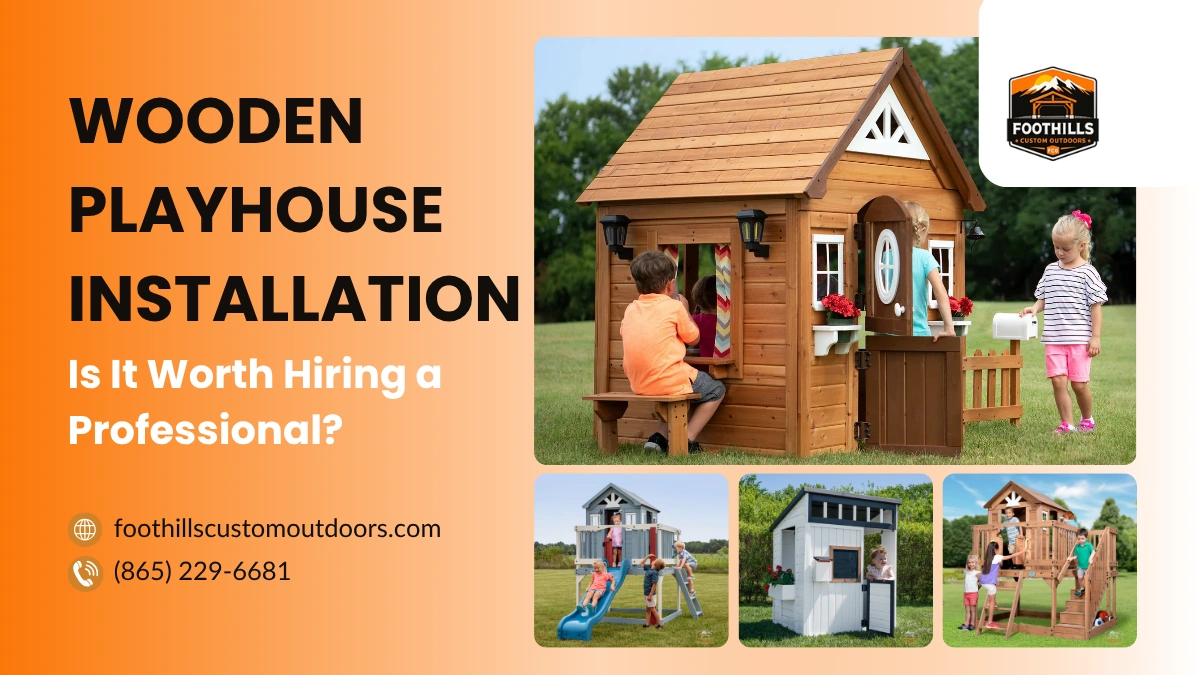
Wooden Playhouse Installation: Is It Worth Hiring a Professional?
You have picked out the playhouse. It arrives on a pallet in your driveway, a stack of pre-cut wood, hardware bags, and a printed manual thicker than a paperback novel. Now the question every parent hits at exactly this moment: do you spend a weekend (or three) putting it together yourself, or do you write a check to a professional installer and let someone else handle it?
The answer depends on more variables than most articles admit. Playhouse size and complexity. Your comfort with power tools. Your available weekends. The strength of Knoxville summer thunderstorms and how well you understand the anchoring that comes in the box. The manufacturer’s warranty terms. The value of your Saturday afternoons. How badly your kids want to be playing in it by next weekend rather than three weekends from now.
This guide works through all of those variables honestly. What a real wooden playhouse installation involves. How hard the assembly actually is (depending on the type). The DIY path with its true time and cost. The professional path with what you actually get for the money. The specific Tennessee wind anchoring realities that make this decision meaningfully different in East Tennessee than in other regions. And definitive verdicts for the most common scenarios, so you can make a real call for your specific situation rather than defaulting to whichever choice seems cheaper on paper.
The Short Answer: When Professional Installation Is Worth It
Yes, hire a professional if: you are installing a mid-size or larger wooden playhouse (over 40 square feet), the playhouse has a solid roof and multiple stories or complex features, you do not own or want to buy the tools required, the yard needs meaningful site preparation, you want to preserve the full manufacturer warranty, or you want your kids playing in the finished playhouse this weekend rather than next month.
Consider DIY if: the playhouse is compact (under 25 square feet), the design is simple (single-story, basic roof, minimal hardware), you have carpentry experience and a full tool set, your yard is already level, you have two full weekends free, and you understand the anchoring requirements for the wind loads Knoxville actually sees.
The middle path: hire a professional for the anchoring and foundation work, and DIY the assembly of the upper structure. This captures 40 to 60 percent of the labor savings while preserving the safety-critical elements that matter most.
The full reasoning follows.
What Wooden Playhouse Installation Actually Involves
Before deciding whether to DIY or hire, understand what the job actually looks like. A modern wooden playhouse in the Backyard Discovery product family and similar quality tiers is not a garden shed and not a doghouse. It is a scaled-down structure with real framing, real roofing, real windows and doors, and real anchoring requirements. The installation runs across five phases regardless of who does the work.
Phase 1: Site preparation
The ground where the playhouse will sit needs to be level within manufacturer tolerance (typically 1 inch of variation across the footprint) and well-drained. Playhouses installed on unlevel or wet ground develop wobble, settling, and rot within a few years. Site preparation for a modest playhouse takes 2 to 6 hours; for a larger playhouse on a sloped or uneven yard, 6 to 16 hours.
Phase 2: Foundation
Small playhouses often sit directly on gravel or a leveled dirt pad with pressure-treated skids underneath. Larger playhouses benefit from a proper foundation: gravel base with concrete footers at the corners, a poured concrete slab, or engineered ground anchors. Foundation work takes 2 to 8 hours depending on the approach.
Phase 3: Frame and floor assembly
The base frame is squared and set on the foundation. Floor joists and floor decking go down. The four wall panels (or the framed studs, if the playhouse ships as pre-cut lumber rather than pre-assembled panels) are erected and squared. Frame and floor assembly typically runs 3 to 8 hours.
Phase 4: Roof, doors, windows, and features
Roof trusses or panels are added. The roof is finished with shingles, metal, or resin panels. Doors, windows, shutters, awnings, and any accessories (climbing walls, slides attached to the playhouse, play kitchens built into the interior) are installed. This is the most variable phase, ranging from 2 to 12 hours depending on complexity.
Phase 5: Anchoring and safety inspection
The playhouse is secured to the ground against wind loads. Every fastener is torqued to specification. Sharp edges, protrusions, and safety hazards are inspected. This phase takes 1 to 3 hours.
Total realistic timeline: 10 to 40 hours of on-site work depending on playhouse size, complexity, and site conditions. Professional crews compress this into a single day or a day and a half. DIY builders typically spread it across 2 to 4 weekends.
How Hard Is It to Assemble a Wooden Playhouse?
The honest answer depends entirely on the type and size of the playhouse. Three categories with meaningfully different difficulty levels.
Compact Playhouses (Under 25 Square Feet)
Small single-story playhouses designed for toddlers and younger children. Pre-cut panels, minimal hardware, single-story design with a simple pitched roof. Assembly runs 6 to 12 hours for two people working carefully.
Difficulty: Moderate. Comparable to assembling a large piece of flat-pack furniture. Requires a power drill, a level, a rubber mallet, and basic hand tools. No power saw needed on most modern kits. Two people is the standard crew.
Common issues: panel alignment on the first wall (once the first wall is square, the rest follows), roof panel handling (heavier than they look), and the anchoring step (often skipped or underdone by DIY builders).
Mid-Size Playhouses (25 to 60 Square Feet)
Single-story playhouses with more features: full-height doors, working windows, front porches, sometimes a small climbing element attached. This is the most common category sold in the Knoxville market and where most of the Backyard Discovery playhouse line sits.
Difficulty: Meaningful. Assembly runs 12 to 24 hours for two people, often spread across two weekends of DIY work. Requires a full power drill set, an impact driver, a circular saw or reciprocating saw for adjustments, a level, ladders, and either a helper willing to hold heavy components or a set of temporary bracing.
Common issues: the roof phase (roof trusses are heavy, working on a ladder while positioning them safely is genuinely difficult solo), wall squareness (small errors early compound into big alignment problems by the roof phase), and window and door installation (getting the openings square enough for the doors to swing properly).
Large and Two-Story Playhouses (Over 60 Square Feet)
Premium playhouses with second stories, climbing walls integrated into the structure, wraparound porches, or attached slides. These are legitimate small buildings.
Difficulty: High. Assembly runs 24 to 48 hours for two people, and often benefits from a third person for the roof and second-story phases. Requires the full tool set above plus safety equipment for working at height (typically 8 to 10 feet on second-story features).
Common issues: stair or ladder to second story (must be installed to child-safe specifications with proper rise and run), structural squareness across the whole build (two-story structures amplify small early errors), and anchoring (larger playhouses catch more wind and need stronger anchoring).
Honest overall difficulty rating for a mid-size wooden playhouse: somewhere between a large shed and a small barn. Not impossible for a handy homeowner. Not trivial. And meaningfully more work than the marketing photos suggest.
The DIY Path: What It Actually Costs and What It Actually Takes
For homeowners considering the DIY route, here is the honest picture.
DIY Time Investment
- Compact playhouse: 8 to 16 hours over 1 to 2 weekends
- Mid-size playhouse: 16 to 32 hours over 2 to 4 weekends
- Large or two-story playhouse: 32 to 60 hours over 4 to 6 weekends
These estimates assume two adults working together, basic carpentry experience, and no major problems along the way. Solo DIY approximately doubles the timeline because the second pair of hands is not there to hold, square, and steady components while the primary builder fastens.
DIY Tool Requirements
Minimum required kit for a mid-size wooden playhouse:
- Cordless drill with a full bit set (Phillips, square-drive, hex)
- Impact driver (strongly recommended for lag bolts and long fasteners)
- Torque wrench for hardware requiring specification torque
- Combination square and framing square
- 4-foot spirit level and a 12-inch torpedo level
- Rubber mallet
- Utility knife
- Tape measure
- Ladder (8-foot minimum for mid-size, 10-foot for two-story)
- Safety glasses, work gloves, ear protection
If you do not already own these tools, expect $400 to $900 in tool investment for a first-time build, though most of those tools have value on other projects.
DIY Direct Cost Savings
Professional installation for a mid-size wooden playhouse typically runs $1,500 to $3,500 in the Knoxville market. That is the cost you avoid by doing the assembly yourself. Larger playhouses can save $3,500 to $6,500 in labor when DIY.
DIY Hidden Costs
The costs most DIY builders do not account for at the start:
- Tool investment (if buying): $400 to $900
- Consumables (extra screws, replacement drill bits, sanding supplies): $50 to $150
- Trips to hardware store for missing hardware or specialty items: 2 to 5 trips typical, adds $50 to $200 in incidentals plus half a weekend of time
- Site prep materials (gravel, sand, landscape fabric, anchoring hardware upgrades): $150 to $600
- Miscellaneous foundation costs if you did not plan for proper anchoring: $200 to $800
Realistic DIY net savings on a mid-size playhouse: $700 to $2,000, not the full $1,500 to $3,500 the labor line item suggests. The gap is real: your time, tools, and small extras all show up in the true total.
DIY Realistic Skill Requirements
You do not need to be a carpenter, but you do need to be genuinely handy. Homeowners who have successfully built a large shed, framed a deck, or installed a fence have the skill baseline. Homeowners whose most complex home project has been assembling flat-pack furniture from an online retailer often underestimate this category.
The specific skills that matter:
- Reading and executing detailed technical instructions with 200 to 400 steps
- Squaring frame components using diagonal measurement (not just corner checks)
- Working safely on a ladder for extended periods
- Setting fasteners to torque specification rather than just tight
- Recognizing when something is wrong before compounding the error into three more steps
If you have these skills, DIY can work. If you have most but not all, the middle-path option (hire the professional for the parts you cannot cover) makes more sense than either pure DIY or full professional install.
The Professional Path: What You Actually Get
Hiring a professional playhouse installer in the Knoxville area typically covers seven elements.
Delivery coordination
Managing the freight delivery, receiving the pallet, moving boxes from the drop point to the installation site. Homeowners handling delivery themselves often discover that a 400-pound pallet of playhouse components does not move easily from the driveway to the backyard.
Site preparation
Ground leveling, drainage assessment, and foundation prep. The specifics of what a Knoxville-area installer covers in site preparation and foundation work depend on the scope agreed at booking, but a typical professional install includes minor grading adjustments and foundation placement.
Inventory verification
Opening every box and checking every component against the manufacturer parts list before assembly begins. Missing or damaged parts get flagged and sourced from the manufacturer or dealer before they stop the build midway.
Assembly
The main build. Frame, floor, walls, roof, doors, windows, accessories. Professional crews work meaningfully faster than DIY because they have installed dozens of playhouses and know where each build phase can slow down.
Anchoring
The critical safety phase, done to specification for the specific site and playhouse. This is where most DIY installs cut corners and most professional installs deliver clear value. More on Tennessee wind anchoring specifically in the next section.
Safety inspection
Every fastener re-torqued. Every hardware joint tightened to specification. Sharp edges, protrusions, and pinch points inspected. Entrapment gaps measured against safety standards.
Warranty preservation and workmanship coverage
Most manufacturers require professional installation to preserve the full warranty coverage on the playhouse. A professional install delivers documentation that supports future warranty claims. The installer also typically carries a workmanship warranty on their own labor, so any issues traceable to the install itself are covered at no additional cost.
For homeowners who want the full picture of what a professional playhouse or playset install actually covers, the companion guide on what’s included in professional playset assembly service walks through the exact same phases in more detail for playsets (playhouse assembly follows the same operational framework with minor variations).
Professional Install Cost in Knoxville
| Playhouse Size | Typical Installed Labor Cost |
|---|---|
| Compact (under 25 sq ft) | $1,000 to $1,800 |
| Mid-size (25 to 60 sq ft) | $1,500 to $3,500 |
| Large or two-story (over 60 sq ft) | $3,000 to $6,500 |
| Playhouse with attached slide, climbing wall, or complex accessories | Add $500 to $2,000 |
| Playhouse requiring meaningful site prep | Add $500 to $2,500 |
Foothills carries a $1,000 minimum labor floor on installation service to cover crew, tools, permitting coordination, and site work even on the smallest builds.
Do Playhouses Need Anchoring in Tennessee Wind?
Short answer: yes, without exception.
Longer answer: this is the single most important safety element of any wooden playhouse installation in East Tennessee, and it is the element most commonly under-executed by DIY builders.
East Tennessee Wind Reality
Knoxville sits in a region with a distinctive wind profile. Winter and spring bring occasional straight-line thunderstorm events with gusts commonly reaching 55 to 70 miles per hour. Summer afternoon thunderstorms roll in with 45 to 60 mile-per-hour gusts several times per season. Every three to five years, a significant severe weather event brings 70 to 90 mile-per-hour gusts across parts of the Knoxville metro. Tornado warnings for Knox, Blount, and Loudon counties happen at least once most years.
A wooden playhouse is essentially a small wind-catching structure with a large roof surface, walls that catch lateral wind pressure, and enough weight to cause serious damage if it becomes airborne. An unanchored or under-anchored playhouse in a Tennessee storm is a hazard to your yard, your house, your neighbors, and any children playing nearby.
The Anchoring Options
Every quality wooden playhouse ships with anchoring hardware appropriate for typical residential wind loads on level ground. The options:
Manufacturer-supplied ground anchors
Most Backyard Discovery playhouses include corner anchors (typically heavy screw-in ground anchors or heavy stakes with tie-down straps) sized for typical residential soil and standard playhouse dimensions. For firm soil, level yards, and playhouses under about 60 square feet, these deliver adequate anchoring for routine wind events.
Concrete footers
Poured concrete footers at each corner post, dropped below the frost line (typically 12 inches in the Knoxville area) and set with anchor bolts before the footer cures. For playhouses over 60 square feet, playhouses on exposed hilltop lots, or homeowners in areas that see the higher end of the regional wind profile, concrete footers are the durable choice. Cost: typically $300 to $800 per footer installed.
Engineered anchor systems
Specialized augers, structural brackets, or engineered tie-downs designed for higher wind loads. For premium playhouses, playhouses in especially exposed sites, or homeowners in the ridge and foothill country of Sevier, Blount, and eastern Knox counties, engineered anchoring provides meaningfully higher load capacity. Cost: typically $600 to $1,800 for a full anchor package.
Foothills’ anchoring and wind protection engineering service covers the full range of anchoring options and does a site evaluation to determine which approach fits your specific location. For most Knoxville-area yards, the manufacturer-supplied anchors are sufficient when properly installed. For exposed sites, the upgrade is worth the cost.
What Happens Without Proper Anchoring
Unanchored playhouses in Tennessee storms have three failure modes:
- Wind lifting the entire structure: A large playhouse can become airborne in a 65-plus mile-per-hour gust and travel meaningful distances. This is the worst-case outcome and can result in serious property damage or injury.
- Wind rocking the structure: Even without lifting, repeated wind pressure can loosen fasteners, crack framing, and cause the playhouse to slowly rack out of square. Over 3 to 5 years, an under-anchored playhouse develops visible lean and structural issues.
- Wall panel separation: In severe gusts, walls can separate from the frame at the fasteners. The structure remains grounded but the walls are compromised.
All three failure modes are prevented by proper anchoring. All three are common in playhouses assembled by DIY builders who under-executed the anchoring phase because it seemed like the boring finishing step after the exciting main assembly.
The Anchoring Bottom Line
If you DIY the playhouse assembly, do not skip the anchoring. Use every anchor supplied in the kit. If you have any doubt about whether the manufacturer anchors are adequate for your specific site, upgrade to concrete footers or engineered anchors. This is the phase where corner-cutting turns into a real safety issue in the years after installation.
Is Playhouse Assembly Worth Paying For?
Here is the actual math for the most common scenario: a mid-size wooden playhouse (40 to 50 square feet) on a typical Knoxville suburban lot.
- Playhouse product cost: $2,500 to $8,000 depending on manufacturer, materials, and features.
- Professional installation cost: $1,500 to $3,500 typical.
- DIY cost: roughly $500 to $1,500 in tools, materials, and hidden expenses.
- Net cost difference: DIY saves $500 to $2,500 versus professional install.
Now the value considerations that determine whether that saving is worth it:
Your time: 16 to 32 hours of skilled labor across 2 to 4 weekends. If your time is worth $30 an hour and you do not enjoy the work, DIY costs you $480 to $960 in opportunity cost. Professional saves that time entirely.
Your skill risk: DIY installations that go wrong (wall out of square, roof leaking after year one, structural issues at year three) can cost more to fix than the professional install would have cost initially. Not all DIY installs go wrong, but the failure mode is meaningful.
Warranty preservation: Most manufacturers offer stronger warranty coverage on professionally installed playhouses. On a $6,000 playhouse, this can be meaningful over a 10-year ownership period.
Peace of mind on anchoring: A properly anchored playhouse holds up to Tennessee storms. An under-anchored one becomes a liability. Professional installs deliver correct anchoring by default; DIY installs require the homeowner to fully understand and execute this phase.
Timeline: Your kids play in the finished playhouse next weekend rather than 4 weekends from now. For families with kids in the sweet spot age range (typically 3 to 9 years old), that timeline compression is genuinely valuable.
Verdict for the mid-size playhouse scenario: for most Knoxville families, professional install is worth the cost. The direct labor saving of $500 to $2,500 is real, but it is offset by 20-plus hours of your time, meaningful skill risk, potential warranty impact, and the timeline compression the professional path delivers. Exceptions apply for genuinely handy homeowners with the tools, the time, and the willingness to invest the effort.
For small playhouses (compact single-story units under 25 square feet), the DIY math shifts. Time investment is 8 to 16 hours across a weekend, professional install typically runs $1,000 to $1,800, and the assembly is genuinely manageable for a handy homeowner. Here, DIY makes real sense for the right person.
For large and two-story playhouses, professional install is the honest answer for nearly everyone. The complexity, safety considerations, and time investment shift the math strongly against DIY.
What Can Go Wrong with a DIY Wooden Playhouse Assembly
The failure modes that show up in real Knoxville DIY installs, ranked by frequency:
Wall panels not squared correctly
The most common issue. A small error on the first wall (a quarter-inch out of square) compounds by the fourth wall into a build that cannot accept the roof cleanly. Rebuilding the base at that point costs a full afternoon of work.
Fasteners not torqued to specification
DIY builders often “hand tight plus a bit more” instead of using a torque wrench to hit the manufacturer’s number. Under-torqued fasteners loosen over the first year and require retightening. Over-torqued fasteners can split wood or strip threads.
Missing anchoring or incorrectly installed anchoring
The most safety-relevant failure. Ground anchors driven at the wrong angle, anchors installed into soil that will not hold them (sandy or rocky ground without appropriate hardware upgrades), or corner anchors skipped entirely because “the playhouse feels heavy enough.”
Roof not properly sealed or flashed
Water intrusion in year one. Shows up as staining on interior walls or persistent damp smell after summer rain.
Doors and windows not installed square
Doors that stick or do not close properly. Windows that leak or will not open. Both traceable to wall panels that were not perfectly square when the openings were installed.
Foundation settling
Ground that was not properly compacted or leveled before the playhouse was set on it. Shows up as visible lean or floor slope within the first year.
Splinters and rough edges not addressed
A safety issue for children. Every exposed edge should be sanded smooth before the playhouse is put into use.
Warranty voidance from unauthorized modifications
DIY builders sometimes substitute fasteners, modify hardware, or make minor design changes that void the manufacturer warranty entirely.
None of these are impossible for a careful DIY builder to avoid. All of them require attention, patience, and a willingness to check work at every phase. Professional crews avoid them because they have installed the same playhouse model many times and know exactly where each failure mode shows up.
The Verdict for Different Homeowners
Definitive calls for the most common scenarios in the Knoxville area.
“I have a small yard, a compact playhouse for a toddler, and enjoy building projects.” DIY. The playhouse is manageable, the time investment is one weekend, and you get the satisfaction of the build.
“I have a mid-size Backyard Discovery playhouse for two kids, and I have never built anything larger than a bookshelf.” Professional. The complexity, tools, and time investment are more than the DIY math justifies, and the anchoring for Tennessee wind is not a phase to learn on a first project.
“I have a large two-story playhouse and a wooded lot with slope.” Professional. Site prep, foundation, structural squareness, and second-story safety are all beyond most DIY skill levels, and the failure modes on this scale of build are more consequential.
“I have professional carpentry experience and want to save the money.” DIY. You have the skills, the tools, and the ability to spot problems as they develop. The anchoring is well within your ability to execute correctly. This is the DIY scenario that works.
“I have a mid-size playhouse and a fully booked calendar for the next three months.” Professional. The professional install compresses the whole project into one day; DIY spreads it across four weekends you do not have.
“I ordered the playhouse before I looked at the assembly manual and now I am not sure what I signed up for.” Very common. Read the manual carefully, watch a video walkthrough if the manufacturer offers one, and reassess. If the answer is “this is more than I expected,” the professional path is available.
“I want to save money but I know I would cut corners on anchoring.” Hybrid path. Hire a professional for the site prep, foundation, and anchoring. DIY the frame, walls, and roof assembly. Captures roughly 40 to 60 percent of the labor savings while preserving the safety-critical phases. This is more common in the Knoxville market than most homeowners realize and is a genuinely viable middle ground.
“I have a large yard, want the playhouse installed by next weekend, and hate power tools.” Professional. You know yourself, and the answer is clear.
Wooden Playhouses for Sale in the Knoxville Area
For Knoxville-area homeowners actively shopping wooden playhouses for sale, the practical starting point is the wooden playhouses collection at Foothills Custom Outdoors, which carries the Backyard Discovery playhouse line at multiple size and feature tiers. Paired with the same professional installation service that handles swing sets and playsets, the full delivery-to-first-play timeline can run under 3 weeks for in-stock models.
For families comparing the professional-install route against the DIY route, the same math discussed above applies. Time investment, skill requirements, tools, and Tennessee wind anchoring drive the decision. The savings on DIY are real but often smaller than the labor line item suggests once time and tool costs are factored in.
Frequently Asked Questions
How long does professional wooden playhouse installation take in Knoxville?
For a compact playhouse, 4 to 6 hours of on-site work. For a mid-size playhouse, 6 to 10 hours. For large or two-story playhouses, 8 to 16 hours, occasionally spread across two days. Site preparation adds another 2 to 8 hours depending on scope. Most installations complete in a single day. The full timeline breakdown for playset installations (which follows the same operational pattern) is covered in the swing set installation timeline guide.
Does DIY assembly void the manufacturer warranty?
It depends on the manufacturer. Backyard Discovery preserves warranty coverage on DIY-assembled playhouses if the assembly follows the manufacturer specifications exactly, but any deviations, substituted fasteners, or design modifications typically void coverage. Professional installation documentation from an authorized dealer strengthens warranty support. Read the specific warranty terms on your playhouse before deciding.
What tools do I really need for a DIY wooden playhouse install?
Minimum: cordless drill, impact driver (highly recommended), torque wrench for spec fasteners, combination square, 4-foot spirit level, rubber mallet, tape measure, ladder rated for the playhouse height, and standard safety equipment. Total tool cost if starting from zero: $400 to $900. Most tools have utility beyond this one project.
Can I install a playhouse on grass without a foundation?
For small playhouses, sometimes yes if the grass area is level, well-drained, and the ground stays firm year-round. For mid-size and larger playhouses, a proper foundation (gravel base, concrete slab, or piers with pressure-treated skids) is strongly recommended. Playhouses installed directly on grass tend to develop settling, wobble, and wood rot at the base within 2 to 4 years.
Do playhouses need to be anchored in Tennessee?
Yes. Every wooden playhouse installed in the Knoxville area needs proper anchoring against the wind loads this region actually sees. Manufacturer-supplied ground anchors are typically adequate for most residential sites; exposed hilltop or ridge lots benefit from upgraded concrete footers or engineered anchoring. Unanchored playhouses are a safety and liability risk in Tennessee’s severe weather profile.
Is professional installation required to keep the warranty?
For Backyard Discovery playhouses, professional installation is not universally required, but it does strengthen warranty support and is a factor in claim resolution. Some manufacturers do require professional installation for full warranty coverage. Check the specific warranty terms on your playhouse.
How much does professional playhouse installation cost in the Knoxville area?
Compact playhouses: $1,000 to $1,800 typical. Mid-size playhouses: $1,500 to $3,500. Large or two-story: $3,000 to $6,500. Playhouses with attached slides or climbing walls add $500 to $2,000. Site prep for meaningful ground work adds $500 to $2,500. Foothills carries a $1,000 minimum labor floor.
Can a professional installer relocate an existing playhouse?
Yes, though the outcome depends on the condition of the hardware and structure. Playhouses that have been outdoors for several years often have weathered hardware, warped wood, and worn components that need replacement during reassembly. A professional service will evaluate the disassembly candidate before quoting the work. Missing hardware and warped lumber often need to be sourced from the manufacturer.
What is the timeline from order to a fully installed wooden playhouse in Knoxville?
For in-stock models: 2 to 4 weeks total (manufacturer prep and freight delivery: 1 to 2 weeks; installation scheduling: 1 to 2 weeks; installation day: 1 day). For back-ordered or custom models, add 2 to 6 weeks on the front end. Peak season (April through July) sees the longer lead times.
Can I have a professional handle just the difficult parts of the install?
Yes, in some cases. A hybrid arrangement where the professional handles the site prep, foundation, anchoring, and safety-critical roof phase while the homeowner handles the wall assembly and finishing work is possible with clear scope definition. This captures meaningful cost savings while preserving the phases that matter most for long-term structural integrity.
What is the difference between assembling a wooden playhouse and a wooden playset (swing set)?
Playhouses are enclosed structures with walls, roof, doors, and windows. Playsets are open structures with decks, swings, slides, and climbing elements. Playhouses generally require more finish work (windows, doors, roof sealing) but less structural anchoring for swing motion loads. Playsets require more structural anchoring but simpler enclosure work. Both benefit from professional installation for the same reasons: complexity, anchoring safety, and warranty preservation. The DIY swing set assembly risk guide covers the safety math on playsets, which mirrors the math on playhouses closely.
What if my yard is not level?
The playhouse needs a level foundation regardless. Options include leveling the yard in the playhouse zone (adding fill dirt and compacting), building a level pad (gravel with concrete footers, or a concrete slab), or building a leveled deck platform for the playhouse to sit on. All three add cost. Professional installers typically evaluate this at the initial site walk and recommend the right approach.
Making the Decision
The professional-vs-DIY decision on wooden playhouse installation is genuinely a case-by-case call, not a universal answer. For handy homeowners with the time, tools, and understanding of anchoring, DIY delivers real savings on compact and mid-size playhouses. For everyone else, the professional path delivers a finished, correctly anchored, warranty-preserved playhouse in a fraction of the total time investment.
The middle path (professional site prep and anchoring, DIY assembly) exists and works well for homeowners who want to capture some of the savings while preserving the safety-critical phases. Ask your prospective installer whether they offer this kind of hybrid arrangement; many Knoxville-area services will accommodate it.
Whatever path you choose, do not underestimate the anchoring. Tennessee wind is real. Playhouses that stand for 15 years and playhouses that develop problems by year three are separated almost entirely by how well the anchoring was executed in that first day of installation. Get that right, and the rest of the ownership experience is straightforward regardless of who put the structure together.