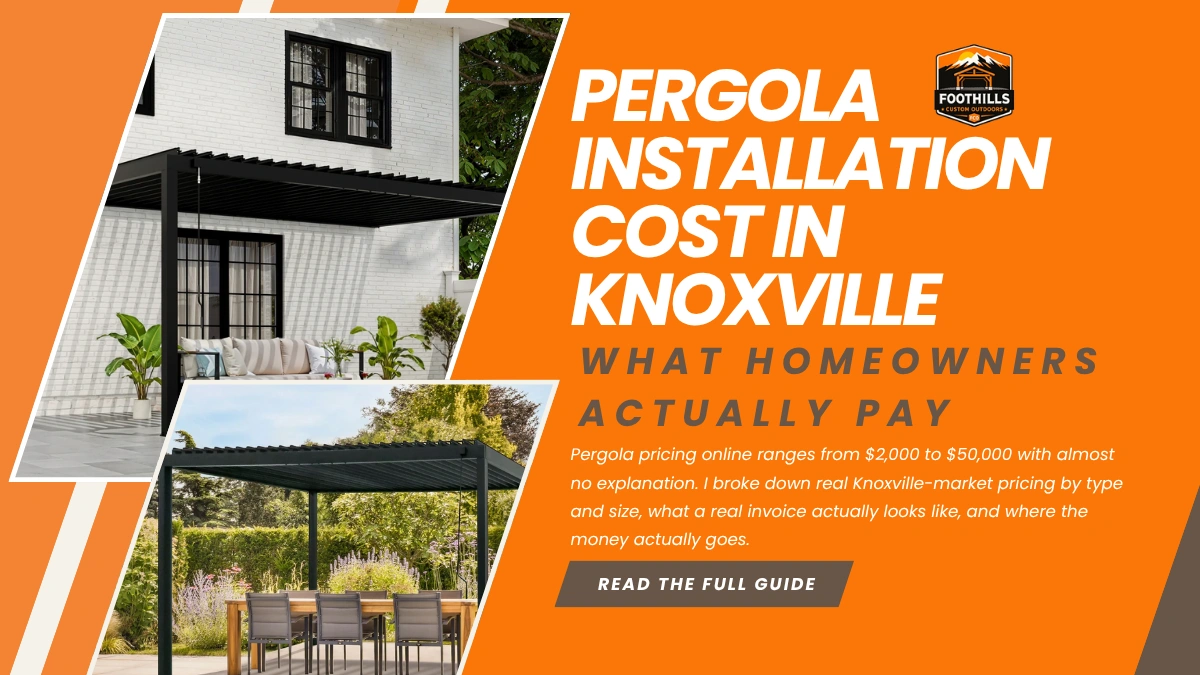
Pergola Installation Cost in Knoxville: What Homeowners Actually Pay
Search “pergola installation cost” and you will find ranges spanning $2,000 to $50,000 with almost no explanation of what drives the difference. That gap is exactly where homeowners get burned: a quote that seemed reasonable turns into a bigger invoice by the time site prep, anchoring, permits, and finish work are added. Or a homeowner who assumed a pergola should cost $4,000 hires the cheapest bid, ends up with a wobbly structure that fails a Knoxville summer thunderstorm, and pays twice.
This guide fixes that. Real Knoxville-market pricing for every common pergola type and size. An honest line-by-line breakdown of what a $12,500 cedar pergola invoice actually looks like. What is included in a professional installation, what usually is not, and why the numbers land where they land. The DIY versus contractor math with real time and tool costs. Foundation and anchoring reality for East Tennessee wind loads. Add-ons that shift the total. And Knoxville-specific factors (HOA rules, permit fees, foothill terrain, clay soil) that other regions do not deal with.
By the end of it, you will know what a fair Knoxville pergola quote should include, what the numbers on it actually mean, and where to push back if something looks off.
The Short Answer: What Pergolas Actually Cost in Knoxville
Real installed pergola pricing in the Knoxville market, product-plus-labor-plus-permits combined:
- Aluminum kit pergola, 10×10 to 12×12: $3,000 to $6,500 installed
- Cedar or pressure-treated wood pergola, 12×12 to 12×14: $5,500 to $10,500 installed
- Larger cedar pergola, 12×16 to 14×16: $8,500 to $16,000 installed
- Aluminum fixed-slat pergola, 12×14 to 14×16: $8,000 to $14,000 installed
- Louvered aluminum pergola, 12×14: $12,000 to $22,000 installed
- Louvered aluminum pergola, 14×16 to 16×20: $16,000 to $32,000 installed
- Motorized premium louvered pergola, 16×20+: $22,000 to $50,000+ installed
- Custom masonry-piered pergola: $15,000 to $45,000+ installed
For the majority of Knoxville homeowners, the target zone is $6,000 to $18,000 installed. Below that range, you are typically looking at DIY kits or freestanding shade structures rather than a professional pergola build. Above it, you are into premium territory with louvered systems or larger custom designs.
Every number above assumes professional installation with proper foundation, anchoring, permits, and the actual labor to put a durable structure in your yard. Kit prices you see online (often $1,500 to $4,000 for the components) do not include the installation cost that turns those components into a finished pergola.
Pergola Installation Cost by Type: The Real Numbers
Pergola pricing splits cleanly by material and system type. Here is what each category actually costs installed in the Knoxville area, with the real trade-offs on each.
| Pergola Type | Installed Cost (Knoxville) | Life Expectancy | Maintenance Level |
|---|---|---|---|
| Pressure-treated pine, 12×12 | $4,000 to $7,500 | 12 to 18 years | Medium (seal every 2-3 years) |
| Cedar, 12×12 | $5,500 to $9,500 | 18 to 25 years | Medium (seal every 3-4 years) |
| Cedar, 12×16 | $7,500 to $13,500 | 18 to 25 years | Medium |
| Redwood, 12×14 | $8,000 to $14,000 | 20 to 30 years | Medium |
| Vinyl (PVC), 12×12 | $6,000 to $10,500 | 20 to 30 years | Low (rinse only) |
| Aluminum fixed-slat, 12×12 | $6,500 to $10,500 | 25+ years | Very low |
| Aluminum fixed-slat, 12×14 | $8,000 to $13,000 | 25+ years | Very low |
| Louvered aluminum (manual), 12×14 | $10,000 to $16,000 | 25+ years | Very low |
| Louvered aluminum (motorized), 12×14 | $12,000 to $22,000 | 20 to 30 years | Low (motor service) |
| Louvered aluminum (motorized), 14×16 | $16,000 to $28,000 | 20 to 30 years | Low |
| Motorized premium, 16×20+ | $22,000 to $50,000+ | 20 to 30 years | Low |
| Custom masonry-piered, wood beams | $15,000 to $45,000+ | 30 to 50 years | Medium (wood only) |
Wood Pergolas: Cedar, Redwood, and Pressure-Treated Pine
Wood remains the most common pergola material in the Knoxville market for aesthetic and cost reasons. The trade-off is maintenance: East Tennessee humidity, freeze-thaw cycles, and summer sun weather untreated wood quickly, and even sealed wood needs re-sealing every 2 to 4 years.
Pressure-treated pine is the entry option. Cheapest at $4,000 to $7,500 installed for a 12×12, but the shortest life expectancy and the highest maintenance demand. Best when budget is the primary driver.
Cedar is the mid-tier standard. $5,500 to $13,500 installed depending on size. Natural rot resistance, attractive weathered gray or stain-able to any tone, holds up well in East Tennessee climate with basic maintenance.
Redwood is the premium wood option. $8,000 to $14,000 installed. Best natural rot resistance of any commonly available lumber, longer life, higher aesthetic value. Availability can be limited in the Knoxville market compared to cedar.
Vinyl and PVC Pergolas
$6,000 to $10,500 installed for a 12×12. Longer life than wood, essentially no maintenance beyond an annual rinse, cleaner modern aesthetic. Not always available in the sizes larger builders offer; some manufacturers only produce vinyl up to certain size limits. Color options limited compared to aluminum.
Aluminum Fixed-Slat Pergolas
$6,500 to $13,000 installed depending on size. Powder-coated aluminum construction, contemporary aesthetic, essentially maintenance-free, longest life expectancy in the standard category. The default choice for modern homes and clean architectural lines.
Louvered Aluminum Pergolas
The category that closes the gap between “shade structure” and “outdoor room.” Adjustable louvers in the roof allow the homeowner to control shade in real time and, on models with integrated drainage, shed rain like a solid roof.
Manual-operated louvers: $10,000 to $16,000 installed for a 12×14. The louvers adjust with a hand crank; more affordable than motorized systems; still delivers full weather control.
Motorized louvered systems: $12,000 to $32,000 installed depending on size. Motor-driven adjustment, often with rain sensors and integrated smart-home controls. The most flexible outdoor cover option available at the pergola tier.
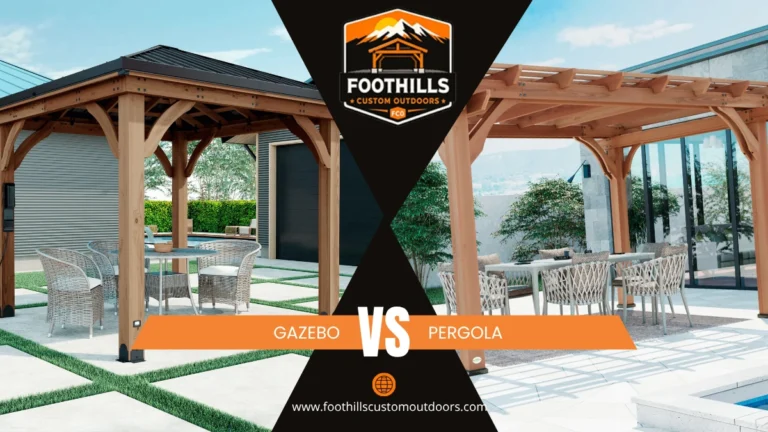
For homeowners weighing whether a pergola or a gazebo makes more sense for their yard, the pergola vs gazebo comparison guide for Knoxville backyards walks through the trade-offs at length.
Custom Masonry-Piered Pergolas
$15,000 to $45,000-plus installed. Full masonry columns (stone, brick, or stucco-clad) supporting wood or aluminum beams and rafters. The highest-end pergola category, effectively a small permanent structure. Life expectancy 30 to 50 years. Common for premium Knoxville-area homes with formal landscape design.
Pergola Cost by Size
Size affects cost meaningfully. Larger pergolas require more material, larger footings, more labor, and often more complex permitting.
| Size | Approximate Footprint (sq ft) | Cost Range (Cedar) | Cost Range (Aluminum Louvered) |
|---|---|---|---|
| 10×10 | 100 | $4,500 to $7,500 | $8,000 to $13,000 |
| 10×12 | 120 | $5,500 to $8,500 | $9,500 to $15,000 |
| 12×12 | 144 | $5,500 to $9,500 | $10,000 to $16,000 |
| 12×14 | 168 | $7,500 to $12,000 | $12,000 to $22,000 |
| 12×16 | 192 | $8,500 to $14,000 | $14,000 to $25,000 |
| 14×16 | 224 | $10,000 to $16,000 | $16,000 to $28,000 |
| 14×20 | 280 | $12,000 to $19,000 | $20,000 to $34,000 |
| 16×20 | 320 | $15,000 to $23,000 | $22,000 to $40,000 |
| 16×24 or larger | 384+ | $18,000 to $30,000 | $28,000 to $50,000+ |
Cost per square foot generally decreases as size increases because fixed costs (permits, site setup, delivery) get spread across more finished area.
What Is Included in a Professional Pergola Installation
The most common source of quote confusion. Here is what a proper Knoxville-area pergola installation quote should cover.
Site evaluation and design confirmation: A walk of the install site with the homeowner, confirmation of placement and orientation, measurement of the actual footprint, identification of any obstacles or challenges. Usually included at no separate cost by reputable installers.
Permitting coordination: Application, filing, and coordination with Knox County or the City of Knoxville building department. Some pergolas under 200 square feet without permanent roofs are exempt; most louvered pergolas and any larger structures require permits.
Delivery coordination and staging: Managing the freight or supplier delivery, moving all materials from the drop point to the install site, staging tools and hardware.
Site preparation: Ground leveling in the pergola footprint, drainage assessment, marking of anchor locations. On level yards, this runs 1 to 3 hours; on sloped or challenging sites, meaningfully longer.
Foundation work: Concrete footers for corner posts (typical for wood pergolas), engineered anchors for aluminum pergolas, or slab attachment for pergolas going over existing patios. This is often where quote differences show up; confirm what type of foundation your installer is including.
Structural assembly: The main build. Posts erected and set plumb, beams installed and squared, rafters or slats added. Every fastener torqued to specification.
Anchoring for wind loads: Critical in East Tennessee. Anchoring approach should be specified for your specific site: standard anchors for level sheltered sites, upgraded engineered anchoring for exposed hilltop or foothill locations. The anchoring and wind protection engineering service covers the site evaluation that determines the right anchoring approach for your yard.
Finish work: Rafter end cuts finished cleanly, hardware covers installed, exposed fasteners hidden where appropriate, any staining or sealing (on wood pergolas) coordinated with the homeowner.
Cleanup and debris removal: All packaging, cutoffs, and construction debris removed from the property. Some quotes include off-site haul-away; others pile debris on the property for homeowner disposal. Confirm which applies.
Homeowner walkthrough and warranty documentation: Final walk of the finished pergola with the homeowner, review of any operating features (louver adjustment, motor operation), delivery of warranty paperwork.
Workmanship warranty: A reputable Knoxville-area installer covers the installation itself for at least one year, often longer, against installation defects. This is separate from the manufacturer warranty on the pergola components.
Real Quote Anatomy: What a $12,500 Cedar Pergola Invoice Actually Looks Like
Enough abstraction. Here is a real-world sample invoice breakdown for a 12×14 cedar pergola installed in the Knoxville area, priced at the middle of the market range.
| Line Item | Cost |
|---|---|
| Pergola product (12×14 cedar, kit or shop-fabricated) | $4,800 |
| Delivery and staging | $250 |
| Site preparation and layout | $450 |
| Concrete footers (4 corner posts, poured and set) | $1,200 |
| Structural assembly labor | $3,200 |
| Anchoring hardware and engineering | $500 |
| Finish work (rafter cuts, hardware covers, cleanup) | $600 |
| Post-install cleanup and debris removal | $300 |
| Permits (Knox County structure permit, coordination) | $200 |
| Workmanship warranty administration | $0 (included) |
| Subtotal | $11,500 |
| Tax (Knox County 9.25%) | $1,064 |
| Grand Total | $12,564 |
Every line item is real. The pergola product itself is only about 38% of the total; the remaining 62% is labor, foundation, anchoring, permits, and site work. This is the ratio that surprises most first-time buyers who assumed the product cost would be the majority of the invoice.
The invoice also does not include several elements that homeowners commonly add later:
- Integrated LED lighting: $400 to $1,800 add
- Outdoor ceiling fan and wiring: $400 to $1,200 add
- Staining or sealing the cedar (initial coat): $300 to $900 add
- Side privacy screens or drop curtains: $600 to $2,800 add
Add all four and the same pergola project easily lands in the $16,000 to $20,000 total range.
Why Pergola Installation Is Expensive
The single most common homeowner question at the quote stage: why does this cost so much? The honest answer has several components, and understanding them helps you separate a fair quote from an inflated one.
Skilled labor is the majority of the cost: As shown in the sample invoice above, labor is roughly 55 to 65 percent of most pergola projects. That labor is skilled trades work: framing, anchoring, hardware, finish carpentry. Skilled labor rates in the Knoxville construction market run $65 to $110 per hour depending on the crew size and specialty. A typical 12×14 pergola takes 20 to 40 hours of on-site work across a two-person crew. At $75 an hour per person, that alone is $1,500 to $3,000 in direct labor.
Foundation work adds real cost: Concrete footers for a four-post pergola typically run $1,000 to $1,800 in the Knoxville market. Compacted gravel bases with anchor systems run $600 to $1,400. Full concrete slabs run $1,800 to $4,500. Foundation is not optional; it is what keeps the pergola from failing in a Tennessee summer storm.
Engineering for wind loads matters here: Knoxville sees several severe thunderstorm events each summer with gusts commonly reaching 55 to 70 miles per hour. Every three to five years, a significant severe weather event brings 70 to 90 mile-per-hour gusts across parts of the metro. Proper anchoring, structural bracing, and foundation depth all cost more than the bare-minimum approach a cheaper installer might use. That premium is what keeps the structure standing when the weather turns.
Permits and coordination take real time: Knox County or City of Knoxville permit fees are moderate ($75 to $300 typical for a pergola structure), but the coordination time (application, drawings, inspection scheduling) adds several hours of project management time that has to be billed somewhere.
Site preparation is often larger than expected: Level yards go quickly. Sloped, wooded, or landscaped yards can require meaningful grading, tree work, or landscape restoration that shifts the labor estimate up. Foothill lots common in Blount and Sevier counties often need more site prep than West Knoxville flat lots.
Delivery, staging, and material handling: A pergola kit or shop-fabricated structure is heavy. A 12×14 cedar pergola typically weighs 400 to 700 pounds distributed across multiple components. Moving those components from a delivery truck to a backyard 60 feet away requires either a small crew or specialized equipment.
Insurance, warranty, and business overhead: Any legitimate installer carries liability insurance, workers’ compensation coverage, and business overhead (vehicles, tools, office administration) that gets built into hourly rates. Uninsured “cheap” installers may offer lower quotes but leave you exposed if something goes wrong.
Regional cost variation: Knoxville pergola pricing tends to run 10 to 20 percent below major metro markets (Nashville, Atlanta, Charlotte) but 5 to 10 percent above rural Tennessee markets due to the higher labor and material costs in urban East Tennessee compared to rural areas.
Put all of that together, and a $12,500 cedar pergola is not overpriced; it is what a properly built, properly anchored, permit-compliant pergola actually costs in this market with skilled labor.
Is It Cheaper to Hire a Pergola Installer or Build It Myself?
DIY is legitimately cheaper on the labor line item. Whether it is worth the total effort depends on several factors.
DIY Pergola Cost
A typical DIY approach for a 12×14 pergola:
- Kit product cost: $2,500 to $5,500 depending on material
- Concrete for footers: $80 to $200
- Hardware and fasteners (beyond kit): $75 to $250
- Tool investment (if starting from zero): $400 to $900
- Consumables (drill bits, blades, sealer): $100 to $300
- Total materials-and-tools DIY cost: $3,155 to $7,150
Time investment: 25 to 60 hours for two people, typically spread across 3 to 6 weekends. First-time DIY pergola builders typically hit the upper end of that range.
Professional Install Comparison
The same 12×14 pergola installed by a professional in the Knoxville area typically lands $8,500 to $16,000 all-in.
Direct DIY savings: approximately $3,000 to $7,000 versus professional installation.
DIY Trade-Offs
What you save: meaningful direct cost. This is the real savings and it can be substantial.
What you spend instead:
- 25 to 60 hours of your weekends across several months
- Learning curve on framing, anchoring, and structural assembly
- Tool investment if you do not already own the necessary equipment
- Any errors that require redoing work (common on first builds)
What you risk:
- Structural failure: A poorly anchored DIY pergola may not survive a serious Tennessee thunderstorm. The failure mode can be property damage, injury, or both.
- Permit and inspection issues: DIY work in Knox County requires the same permitting as professional work. Missed permits can create issues at resale.
- Warranty complications: Manufacturer warranties on kit pergolas typically require proper installation to specification. DIY installs that deviate from specification void coverage.
- Aesthetic and structural imperfections: A pergola out of square by even half an inch across the diagonal shows visibly for the life of the structure.
- Insurance implications: Some homeowner insurance policies exclude coverage for structures not built by licensed professionals, especially structures that fail during severe weather.
Honest Verdict
For genuinely handy homeowners with construction experience (framed a deck, built a shed, hung interior doors), DIY pergola construction is a real cost-saving option. You have the skills, the tools, and the ability to spot problems as they develop.
For handy-but-not-professional homeowners, the middle path (hire a professional for foundation and anchoring, DIY the beam-and-rafter assembly under their guidance) can capture 30 to 50 percent of the labor savings while preserving the safety-critical elements. Not every installer offers this arrangement; ask at the quote stage.
For most Knoxville homeowners without meaningful construction experience, professional installation is the honest choice. The direct cost savings on DIY are real but the risk exposure, time cost, and quality variance typically make the professional route the better total value.
Foundation and Anchoring Costs in East Tennessee
Foundation is where quality separation shows up most clearly and where cheap quotes often cut corners that come back to cause problems.
Foundation Options and Real Knoxville Cost
| Foundation Approach | Typical Installed Cost | When Appropriate |
|---|---|---|
| Ground anchors (surface-driven) | $150 to $600 | Small aluminum kits on firm level ground; not recommended for permanent installs |
| Concrete footers (4 corner posts) | $800 to $1,800 | Standard for most wood pergolas |
| Concrete piers (below frost line) | $1,200 to $2,800 | Larger pergolas, exposed sites |
| Poured concrete slab | $1,800 to $4,500 | Best long-term, permanent installs |
| Attachment to existing patio | $300 to $1,200 | Retrofit to structurally sound existing surface |
| Full masonry pier system | $3,500 to $8,000 | Custom masonry-piered pergolas |
A common source of confusion: cheap online kit descriptions imply that ground anchors are sufficient for permanent pergola installation. In the Knoxville wind profile, they are not, except for the smallest lightweight structures on level protected ground. For any pergola over 10×10 or intended to last more than 10 years, concrete footers or piers are the correct approach.
Compacted gravel and paver bases do not anchor a pergola on their own. They require separate concrete footers or engineered ground anchors underneath. Once you tally gravel plus footers plus install labor, a poured concrete slab often comes out cheaper, cleaner, and stronger than the pieced-together approach. This is the same math that applies to other outdoor structures and is covered in more depth in the site preparation and foundation service guide.
East Tennessee Wind Anchoring Reality
Knoxville homeowners in exposed hilltop or ridge lots (common in Blount, Sevier, and eastern Knox counties) benefit from upgraded engineered anchoring. Standard concrete footers rated to typical residential wind loads may not carry the safety margin needed for sites that see 75-plus mile-per-hour gusts several times a decade.
Cost of engineered anchoring upgrade: typically $400 to $1,200 above standard footer cost. On a $12,000 pergola in an exposed site, this is 3 to 10 percent of the total project cost and buys meaningful additional safety margin.
Add-Ons and Upgrades That Change the Total
The base pergola cost is only the starting point for many builds. Common add-ons and their typical Knoxville-area cost:
| Add-On | Typical Installed Cost |
|---|---|
| LED strip lighting under beams | $400 to $900 |
| Recessed dimmable LEDs in posts/rafters | $700 to $1,800 |
| Integrated smart-home lighting control | $500 to $1,500 |
| Outdoor ceiling fan (wired and installed) | $600 to $1,500 |
| Speaker system (Bluetooth or hardwired) | $500 to $1,800 |
| Weatherproof television and mount | $700 to $2,500 |
| Retractable canopy (motorized) | $1,500 to $4,500 |
| Retractable side screens | $800 to $3,000 |
| Drop-down side curtains (manual) | $400 to $1,500 |
| Integrated drainage system | $500 to $1,800 |
| Motorized louvered upgrade (from manual) | $2,500 to $5,500 |
| Rain sensor for motorized louvers | $250 to $800 |
| Stain or sealer application (initial coat) | $300 to $1,100 |
| Climbing plant support wires and hardware | $200 to $600 |
| Integrated planters at post bases | $600 to $2,000 |
| Outdoor kitchen integration (electrical/gas prep only) | $800 to $3,500 |
For homeowners planning a pergola that anchors an outdoor cook zone underneath, the electrical and gas prep work integrates naturally with a broader outdoor kitchen build. Coordinating both projects together typically saves 10 to 20 percent versus adding them separately in later phases.
Knoxville-Specific Cost Factors
Every market has its own cost drivers. Here is what shifts pergola pricing in East Tennessee specifically.
Clay soil: Much of the Knoxville area sits on clay soil that shrinks in summer and swells with winter moisture. This movement stresses foundations. Proper footer depth (below the 12-inch frost line typical for the area) is not optional here; skipping it saves money in year one and creates cracking problems by year three.
Foothill terrain and sloped lots: Common in Blount, Sevier, and eastern Knox counties. Leveling a sloped install area, or building a partial retaining wall to create a level pad, can add $500 to $3,500 to the project. Confirm site conditions at the quote stage.
Rocky ground: Ridge lots and hillside properties often have rock close to the surface. Standard footer drilling may not work; specialized equipment or alternative anchoring adds cost.
HOA architectural review: Farragut, Northshore, Sequoyah Hills, Rocky Hill, and much of West Knoxville carry stricter architectural review. Getting written approval before installation is required. The review process itself is usually free but adds 2 to 6 weeks to the project timeline, which affects when the installer can schedule your build.
Permit fees: Knox County and City of Knoxville pergola permit fees typically run $75 to $300. Most freestanding pergolas without permanent roofs and under 200 square feet may qualify for exempt or simplified permitting. Louvered pergolas and larger structures typically require full permits.
Peak season demand: March through July is peak pergola construction season in the Knoxville area. Lead times stretch, contractor availability tightens, and pricing sometimes reflects the demand. Booking in fall or winter can access modest savings and shorter lead times, though weather-driven reschedules become more common.
Freeze-thaw considerations: 40 to 50 overnight freezes per year drive material selection. Aluminum and vinyl handle freeze-thaw well; wood requires proper sealing to survive; concrete footers need to be poured to full frost-line depth.
Local material availability: Cedar is widely available in the Knoxville market at reasonable pricing. Redwood is available but limited. Louvered aluminum systems are available through several regional distributors. Exotic hardwoods (ipe, teak) require special order and add meaningfully to cost.
How to Read a Pergola Installation Quote
A proper quote should include every element below in itemized detail. If your quote does not, ask the installer to break it out before signing.
Essential quote line items:
- Pergola product (make, model, size, material specification)
- Delivery and staging labor
- Site preparation scope and labor hours
- Foundation type and cost (footers, slab, piers, existing patio attachment)
- Structural assembly labor
- Anchoring hardware and approach specified for your site
- Finish work scope (rafter cuts, hardware covers, sealing coordination)
- Debris removal (on-property placement vs off-property haul-away)
- Permit fees and coordination
- Any add-ons (lighting, fans, electrical, upgrades) itemized separately
- Warranty terms (product warranty and workmanship warranty separated)
- Payment schedule (deposit, milestones, final)
Red flags on a quote:
- Single line-item price with no breakdown
- No mention of foundation or anchoring specification
- No permit coordination included
- Warranty terms not documented in writing
- Payment demanded in full upfront
- No workmanship warranty offered
- Deep discount versus other quotes without clear explanation
Comparing quotes across installers requires that both quotes cover the same scope. A cheap quote that excludes foundation work or anchoring is not comparable to a comprehensive quote that includes them. Ask each installer to break their quote into the same format so the comparison is apples to apples.
Where to Save Money vs. Where to Spend It
If the budget is a real constraint, here is where to prioritize and where corners can be cut without long-term regret.
Spend the money on:
- Foundation. Concrete footers or piers are what keep the pergola standing. Not the place to save.
- Anchoring specification. Engineered anchoring in exposed sites costs a modest premium and pays back in year five.
- Structural material quality. Cedar over pressure-treated pine, powder-coated aluminum over uncoated, redwood over cedar if the budget stretches.
- The installer’s insurance and warranty. Verify both in writing.
- Permits. Non-optional and cheap; skip them and you pay at resale.
Save the money on:
- Add-on features in year one. Skip the motorized louvers, the smart lighting, the ceiling fan. Add them later as you learn how you actually use the pergola.
- Premium finish upgrades. Standard rafter end cuts look fine on most pergolas; premium decorative cuts add cost with limited functional benefit.
- Retractable canopies. Add-on canopies over pergolas often disappoint compared to committing to a full louvered pergola or a permanent cover. Consider skipping the canopy and either living with the open pergola or upgrading to louvered.
- Custom stain colors. Standard stain colors cost less and look identical to premium custom mixes on most cedar pergolas.
Cost Comparison with Related Outdoor Structures
For homeowners considering multiple outdoor structure options, here is how pergola pricing compares to nearby categories in the Knoxville market.
| Structure | Typical Installed Cost (Knoxville, mid-range) |
|---|---|
| Standard cedar pergola, 12×14 | $8,500 to $12,000 |
| Louvered aluminum pergola, 12×14 | $12,000 to $22,000 |
| Cedar gazebo, 12×14 | $10,000 to $15,000 |
| Vinyl gazebo, 12×12 | $6,500 to $10,000 |
| Full pavilion, 12×16 | $14,000 to $22,000 |
For a full parallel analysis of one nearby category, the gazebo installation cost in Knoxville guide walks through the numbers on that structure category in the same detail as this guide covers pergolas.
Frequently Asked Questions
What is the average pergola installation cost in Knoxville?
The median installed pergola project in the Knoxville area falls between $8,000 and $14,000. That range covers the most common builds: cedar or aluminum 12×14 pergolas with proper foundation and anchoring, standard finish work, and permits. Smaller builds under 12×12 run lower ($4,500 to $8,000). Louvered aluminum systems run higher ($12,000 to $25,000). Custom masonry-piered pergolas run higher still ($15,000 to $45,000-plus).
Is a pergola cheaper than a gazebo?
Usually yes, at comparable size. A 12×14 cedar pergola in the Knoxville market runs $8,500 to $12,000 installed; a 12×14 cedar gazebo runs $10,000 to $15,000 installed. The gazebo costs more because it includes a solid roof, screens or railings, and more complex construction. Both structures are valid choices; the differences show up most clearly for entertaining use cases like a grill gazebo or covered outdoor bar build where a solid roof matters.
How long does professional pergola installation take?
For a standard 12×14 wood or aluminum pergola: 1 to 2 days on-site once the crew arrives. Site prep may take another partial day if not already done. Louvered aluminum pergolas typically take 2 to 3 days. Custom masonry-piered pergolas can extend to 5 to 10 days. Add 2 to 6 weeks upstream for permitting, material lead time, and scheduling, especially in peak season.
Do I need a permit for a pergola in Knoxville?
Depends on size, roof type, and jurisdiction. Freestanding pergolas under 200 square feet without permanent roofs often qualify for exempt or simplified permitting. Louvered pergolas and any structure over 200 square feet typically require permits. Attached pergolas (connected to the house structure) almost always require permits. Confirm with your local building department; a good installer coordinates this as part of the quote.
Why is pergola installation so expensive?
Labor is roughly 55 to 65 percent of most pergola project costs. The remaining 35 to 45 percent covers the pergola product itself, foundation materials, hardware, permits, and cleanup. The labor component covers skilled construction work (framing, foundation, anchoring) that requires a trained crew, tools, insurance, and warranty coverage. A properly built pergola priced at $12,500 is not overpriced; it reflects the real cost of skilled construction labor in the Knoxville market.
Can I install a pergola over an existing patio?
Yes, if the patio surface is structurally sound and level. The installation approach uses through-slab or surface-mount anchors to attach the pergola posts to the existing patio. A site evaluation confirms the patio can carry the load. Cost impact is generally lower than building a new foundation, though it depends on the patio condition.
Are DIY pergola kits worth it?
For genuinely handy homeowners with construction experience and available weekends, DIY kits can save $3,000 to $7,000 on a mid-size pergola compared to professional installation. For homeowners without meaningful DIY experience, the savings often evaporate in tool costs, mistakes, and time investment. The middle path (professional foundation and anchoring, DIY assembly of the upper structure) captures some savings while preserving the safety-critical phases.
What is the cheapest way to get a pergola in Knoxville?
Small aluminum kit installed on an existing patio with basic anchoring: roughly $3,000 to $5,500 total. Below that, you are looking at freestanding shade structures rather than permanent pergolas. Foothills does not price installed pergola builds below the $3,000 range because a smaller scope typically does not deliver a lasting outcome. Foothills carries a $1,000 minimum labor floor.
How much does it cost to add lighting to a pergola?
Basic LED strip lighting installed under the beams: $400 to $900. Recessed dimmable LEDs in posts or rafters: $700 to $1,800. Integrated smart-home lighting with app control: $1,200 to $2,500. Cheapest option is post-install DIY string lights ($100 to $300), though these are less integrated and less durable than professionally installed lighting.
Does a pergola add value to a Knoxville home?
Generally yes. A well-built pergola typically returns 50 to 65 percent of its installation cost at resale in the Southeast region, according to general remodeling ROI data. Louvered aluminum pergolas and premium wood pergolas hold value better than basic kit installations. Value contribution is stronger when the pergola is integrated with a broader outdoor living plan (patio, kitchen, landscape) rather than standing alone.
What is the difference between a pergola quote and a pergola contract?
A quote is an itemized cost estimate for a specific scope. A contract is the binding agreement that follows the quote, covering scope, payment schedule, timeline, warranty terms, change-order procedures, and cancellation policy. Never start work on the basis of a quote alone; sign a proper contract that documents everything. A reputable installer provides both without hesitation.
Can I finance a pergola installation?
Yes. Most homeowners pay for pergola installation through cash, home equity line of credit (HELOC), contractor financing partnerships, or standard home improvement loans. HELOC is typically the most cost-effective for builds over $10,000 given the tax treatment and interest rates. Some installers offer or partner with third-party financing; read terms carefully.
Working with a Pergola Installer in the Knoxville Area
The right pergola installer delivers three things: an honest itemized quote up front, quality craftsmanship in execution, and a workmanship warranty that stands behind the finished result. Verify insurance, verify permits, and read the workmanship warranty carefully before signing. Confirm what is and is not included in the base quote so add-ons do not surprise you later.
Foothills Custom Outdoors serves Knoxville, Farragut, Hardin Valley, Bearden, Maryville, Alcoa, Sevierville, Oak Ridge, and the broader East Tennessee area with a curated pergola product lineup paired with complete pergola installation and assembly service that handles permits, foundation, anchoring, and finish work under one contract. The pricing in this guide reflects the Knoxville-market reality Foothills operates in and the quality tier the service delivers.
A well-built pergola in East Tennessee lasts 20 to 30 years with basic maintenance. The installation itself takes 1 to 3 days on site. Getting those 1 to 3 days right (proper foundation, engineered anchoring for Tennessee wind, permit compliance, skilled assembly) is what determines whether the next 20-plus years are worry-free or become a slow parade of settling issues, wobble complaints, and repair calls. Pay for the quality build up front. It is cheaper in the long run than trying to fix a cheap install later.