Pergola vs. Gazebo: Which One Is Right for Your Knoxville Backyard?
Ask five Knoxville homeowners what the difference is between a pergola and a gazebo, and you will get five different answers. That confusion costs people money. A homeowner who wants a shaded reading spot but buys a full gazebo overspends. A homeowner who wants a dry, all-weather outdoor dining room but buys an open pergola ends up eating indoors every time an August thunderstorm rolls through. The two structures look similar in catalog photos, but they are engineered for different jobs, and the choice that fits your yard depends heavily on Knoxville-specific factors that generic comparison guides never address.
This guide gives you the honest side-by-side you need. Real cost bands. Real weather protection ratings against East Tennessee conditions. Real HOA and permit considerations for Knox, Blount, and Sevier County properties. A third structure, the pavilion, that most comparison articles skip entirely. Pros and cons for each option, definitive verdicts for the most common backyard scenarios, and answers to the questions homeowners actually ask before they buy.
By the end of it, you should know whether you want a pergola, a gazebo, or a pavilion, why, and roughly what it will cost installed in the Knoxville area.
Pergola vs. Gazebo at a Glance
Before we go deep, here is the shorthand you can screenshot and send to your spouse.
| Factor | Pergola | Gazebo |
|---|---|---|
| Roof | Open slats, rafters, or louvers (partial shade) | Solid hardtop or shingled roof (full protection) |
| Weather protection | Filtered shade only. No rain coverage on standard models. | Full sun, full rain, light snow protection. |
| Airflow | Maximum. Open on top and all sides. | Good with open sides. Solid roof can trap summer heat. |
| Shape | Rectangular or square, typically | Octagonal, hexagonal, or oval, typically |
| Style | Modern, minimalist, architectural | Traditional, cottage, garden pavilion |
| Typical installed cost (Knoxville) | $2,500 to $8,000 (standard); $8,000 to $22,000+ (louvered) | $4,000 to $8,500 (entry); $9,000 to $22,000+ (premium) |
| Foundation | Ground anchors, concrete footers, or slab | Concrete footers, slab, or engineered anchor system |
| Permit complexity in Knox County | Lower (open structure, often exempt under size limits) | Higher (roofed structure, more likely to require review) |
| Best for | Defining a space, filtered shade, climbing plants, modern look | All-weather outdoor rooms, entertaining, hot tub cover, kitchen shelter |
| Lifespan (well-built, professionally installed) | 15 to 25 years | 20 to 30 years |
Both structures deliver value. Which one delivers it to your specific yard depends on the deeper comparisons below.
What Is a Pergola?
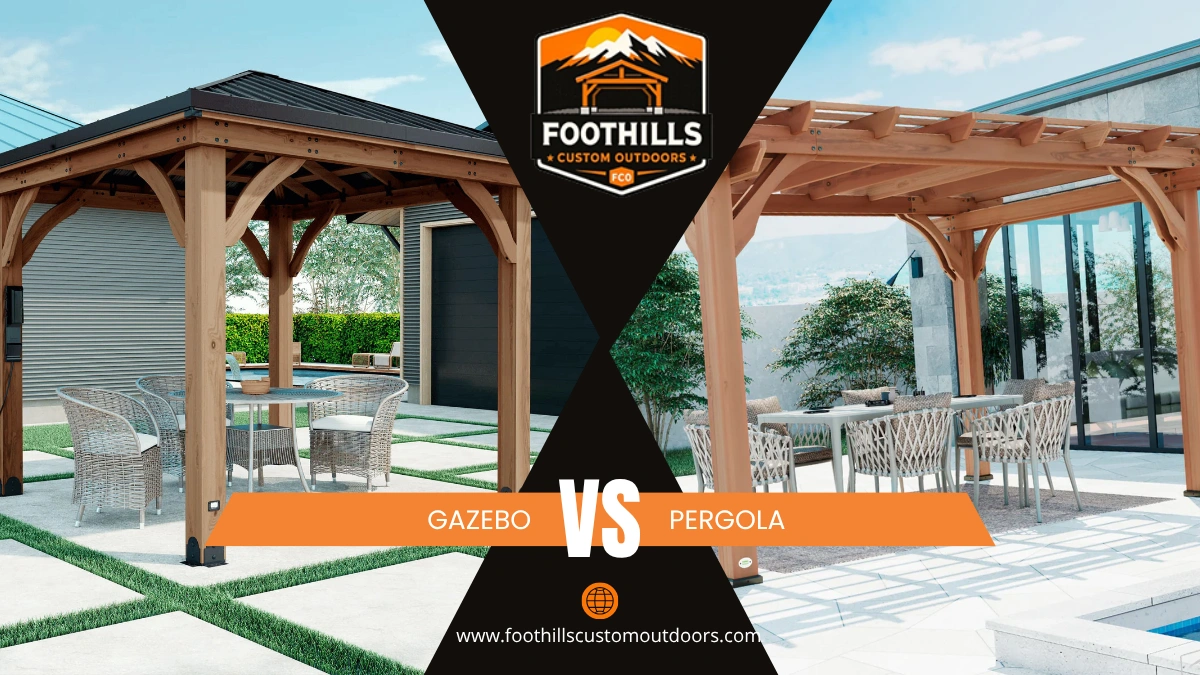
A pergola is an open-air structure with a rectangular or square footprint, four (sometimes two) vertical posts, and a roof made of open crossbeams, slats, or adjustable louvers. It is engineered to define an outdoor room, filter direct sunlight into a comfortable dappled shade, and frame views without enclosing the space. Traditional pergolas were wooden and often supported climbing plants like wisteria, roses, or grape vines. Modern pergolas are increasingly aluminum, powder-coated, and either fixed-slat or motorized louvered systems that can adjust from fully open to nearly closed.
Standard sizes range from 10 by 10 feet at the small end to 20 by 20 or larger for full outdoor-room applications. Foothills carries a curated selection of pergolas in the sizes and materials that hold up well in East Tennessee weather. Structurally, pergolas sit lighter on the ground than gazebos and often require simpler foundations, though anchoring for wind resistance is still critical in the Knoxville area, where straight-line summer storms can drive gusts above 60 miles per hour.
The core promise of a pergola: filtered shade, defined space, open feel.
What Is a Gazebo?
A gazebo is a fully roofed freestanding structure, most often octagonal or hexagonal, with open or partially screened sides. The solid roof, historically shingled but now available in metal, polycarbonate, or heavy-duty vinyl-clad panels, provides complete overhead protection from sun, rain, and light snow. Sides are typically open railings or half-walls that can be upgraded with screens, curtains, or fixed panels for privacy and insect protection.
Standard gazebo sizes run from 8 by 8 feet at the small end (a corner reading nook) through 12 by 14 feet (a full dining room) to 14 by 16 feet or larger for entertaining setups. Roof pitch is meaningful in Knoxville: steeper pitches shed rain, ice, and the occasional pine straw load from surrounding trees more effectively than shallow ones. Foothills’ gazebos collection is built around models with proper pitch, engineered anchoring, and material choices matched to Tennessee humidity and freeze-thaw cycles.
The core promise of a gazebo: complete overhead cover, distinct architectural presence, all-weather usability.
Pergola Pros and Cons for Knoxville Homes
Every structure carries trade-offs. Here is the honest ledger on pergolas in East Tennessee.
Pergola strengths in the Knoxville area
- Lower entry cost. A quality installed pergola typically runs $2,500 to $8,000 in this market, compared with $4,000 or more for even an entry-level installed gazebo.
- Better airflow in summer humidity. Knoxville hits 75 to 85 percent humidity through much of July and August; an open pergola stays cooler underneath than a solid-roof gazebo of the same size.
- Better sightline preservation on foothill-facing lots. If your yard opens toward a ridge, mountain, or wooded slope, a pergola frames the view rather than blocking it.
- Faster and lighter permitting for most Knox County and City of Knoxville properties, since open-air structures under 200 square feet often fall under exempt or simplified review.
- Louvered aluminum systems offer flexibility: fully open in mild weather, closed against rain, tilted for morning versus afternoon sun.
- Cleaner integration with modern architecture, contemporary decks, and pool decks.
Pergola weaknesses in the Knoxville area
- Standard fixed-slat pergolas provide no rain protection. A surprise thunderstorm sends everyone inside.
- No barrier against pine straw, oak catkins, or the significant pollen load that East Tennessee spring drops on any horizontal surface.
- Wooden pergolas without a maintenance plan can weather badly under our humidity and freeze-thaw cycles. Cedar and pressure-treated pine both need sealing every 2 to 4 years.
- Louvered aluminum systems, while more capable, run $8,000 to $22,000 installed for a residential-scale unit.
- Limited protection for expensive outdoor furniture or a grill placed underneath. Cushions and appliances still need covers.
Pergolas are the right answer when you want to define a space, get quality shade in fair weather, and are comfortable with the fact that heavy rain still sends you indoors.
Gazebo Pros and Cons for Knoxville Homes
The gazebo ledger:
Gazebo strengths in the Knoxville area:
- Complete rain protection. A summer thunderstorm becomes a viewing event rather than a party-ender.
- Sun protection for hot tubs, outdoor furniture, and equipment underneath. Furniture life extends significantly.
- Screens and curtains can convert a gazebo into a mosquito-free outdoor room, valuable in Knoxville from May through October when mosquitoes are active.
- Structural presence that reads as a permanent architectural feature and often carries stronger appraised value than an open pergola of similar cost.
- Overhead surface for hanging lighting, ceiling fans (a real comfort upgrade in Tennessee summers), and speakers.
- Longer usable seasons: the covered space stays comfortable in light drizzle, spring pollen, and mild winter days when a pergola would be unusable.
Gazebo weaknesses in the Knoxville area:
- Higher installed cost floor. Foothills does not sell any all-in installed gazebo below $4,000, and mid-range 12 by 14 cedar gazebos typically land $8,000 to $14,000 installed. Premium 14 by 16 and larger builds run $15,000 to $28,000.
- Larger visual footprint. On smaller lots, a full gazebo can consume the yard aesthetically.
- Sightline block. A solid-roof gazebo interrupts a foothill view line from the house that a pergola would preserve.
- More involved permitting and often more HOA scrutiny in stricter subdivisions (Farragut, Northshore, Sequoyah Hills, Rocky Hill).
- Solid-roof structures under mature East Tennessee trees can accumulate significant debris and require periodic roof cleaning to preserve finish and drainage.
- Wooden gazebos need periodic staining or sealing (every 2 to 4 years) to survive humidity and freeze cycles.
Gazebos are the right answer when you want a real outdoor room that works in any weather and you have the budget and the yard for it.
Gazebo vs. Pergola vs. Pavilion: Which Is Better?
Most comparison articles stop at pergola versus gazebo, but the pavilion is worth adding to any serious backyard structure conversation, especially in Knoxville where hosting large groups (Vols home games, extended-family cookouts, church small groups) is a real use case.
A pavilion is a fully roofed freestanding structure like a gazebo, but with a rectangular footprint (rather than octagonal), a larger typical size, and a more open, entertainment-forward layout. Think of a pavilion as a covered outdoor room built at scale: 12 by 16, 14 by 20, or 16 by 24 feet is not unusual. The roof is solid, often gabled, and the sides are typically fully open (no railings, no screens) to maximize group flow underneath.
Pavilion strengths in Knoxville:
- Best structure for hosting 12+ people at once. Rectangular geometry seats a long dining table plus lounge seating.
- Full weather protection like a gazebo, with a larger clear-span footprint.
- Ideal cover for a full outdoor kitchen with cook zone, prep counter, bar seating, and dining zone all underneath.
- Cleanest architectural pairing with country and craftsman homes common across East Tennessee.
Pavilion trade-offs:
- Highest cost of the three: 12 by 16 pavilions install in the $12,000 to $22,000 range; 14 by 20 and larger builds run $18,000 to $40,000-plus.
- Highest permitting and HOA scrutiny.
- Requires substantial concrete footer or slab foundation.
- Longest installation timeline (typically two to four days on site for professional builds).
Quick verdict:
- Choose a pergola for filtered shade, defined space, or view preservation on a moderate budget.
- Choose a gazebo for all-weather cover on a medium footprint with a distinct architectural presence.
- Choose a pavilion when you regularly host groups of eight or more and want a genuine outdoor room.
The Weather Question: How Each Structure Handles East Tennessee Conditions
Weather is the deciding factor for most Knoxville homeowners, and every structure interacts differently with the specific conditions we deal with here.
Summer humidity (June through September, typically 70 to 85 percent RH). Pergolas breathe. Gazebos and pavilions can trap heat under a solid roof, though a ceiling fan solves this cheaply. Aluminum louvered pergolas offer the best of both: closed against sun, open against still air.
Thunderstorms and heavy rain (average 50 inches annually, with intense summer downpours). Pergolas lose here decisively. A standard pergola offers no rain cover. Louvered pergolas closed against rain hold up well if properly installed and drained. Gazebos and pavilions shed rain reliably as long as the roof pitch is at least 4:12 and drip lines are managed.
Straight-line summer storms and occasional tornado weather. East Tennessee sees several severe thunderstorm warnings each summer with gusts commonly reaching 55 to 70 miles per hour. Every outdoor structure in this region needs proper anchoring and wind protection engineering. Concrete footer anchoring with structural fasteners is the standard; ground stakes and surface anchors are not sufficient for our storm profile.
Freeze-thaw cycles (40 to 50 overnight freezes annually in Knoxville). Wooden structures need maintenance to survive this cycle. Aluminum, vinyl-clad, and properly treated cedar all handle it well. Metal roofing outperforms shingles for longevity in freeze-thaw conditions.
Ice storms (rare but significant, average one major event every 3 to 5 years). Solid-roof gazebos and pavilions carry an ice load better than louvered pergolas with the louvers closed. Well-built structures handle ice; poorly anchored ones fail.
Pollen and debris (heavy spring load from oak, pine, and hickory). Solid roofs collect debris and need periodic cleaning. Open pergolas let debris fall through to whatever is underneath, which may include cushions and appliances.
Winter usability. All three structures are usable in mild Knoxville winters with the right setup: portable heaters, curtains, wind screens. Gazebos and pavilions with side panels installed extend the season further than pergolas.
Cost Comparison in the Knoxville Market
Cost is where most decisions come down to earth. Every number below is a real-world installed cost band for the Knoxville area, including product, professional site preparation, and installation labor. These are not manufacturer list prices.
| Structure Type | Typical Installed Cost (Knoxville) | What You Get |
|---|---|---|
| Standard aluminum pergola, 10×10 to 12×12 | $2,500 to $5,500 | Powder-coated aluminum frame, fixed slats or basic canopy, ground-anchor foundation |
| Cedar or wood pergola, 12×12 to 12×16 | $4,500 to $9,000 | Solid wood frame, decorative rafters, professional install with anchoring |
| Louvered aluminum pergola, 12×14 to 14×16 | $8,000 to $22,000 | Motorized or manual louvers, integrated drainage, robust anchoring |
| Entry vinyl or resin gazebo, 10×10 to 10×12 | $4,000 to $6,500 | Hardtop roof, factory-anchored posts, screen or railing package |
| Cedar wood gazebo, 12×14 | $8,000 to $14,000 | Wood construction, shingled or metal roof, screens, professional install |
| Premium gazebo, 14×16+ | $15,000 to $28,000+ | Full construction, upgraded materials, cedar or hardwood, custom finishes |
| Pavilion, 12×16 | $12,000 to $22,000 | Rectangular footprint, gabled roof, open sides, concrete foundation |
| Pavilion, 14×20 to 16×24 | $18,000 to $40,000+ | Larger clear-span build, higher engineering demand |
Two important floors specific to Foothills’ pricing structure:
- Minimum installed gazebo package: $4,000 all-in. Nothing lower is a serious build for the Knoxville market.
- Minimum installation labor fee: $1,000. This covers the crew, equipment, permitting coordination, and site work even on the smallest builds.
A common source of cost surprise is the foundation. Compacted gravel and paver bases do not provide anchoring against wind on their own; they require separate concrete footers or ground anchors to hold the structure in a Knoxville-scale storm event. Once you tally gravel plus footers plus install, a poured concrete slab often comes out cheaper, cleaner, and stronger. A conversation with a contractor about proper site preparation and foundation options before ordering the structure is time well spent.
Which One Wins for Each Common Backyard Use?
Different jobs, different answers. Here is the honest verdict for the most common uses in Knoxville backyards.
For a shaded dining area on a modest patio. Pergola wins. Filtered shade, low cost, defines the space, does not overwhelm a smaller yard. Choose a louvered pergola if you want rain flexibility.
For an outdoor kitchen or grill station. It depends on the kitchen’s own cover. If the grill is unprotected, a gazebo or pavilion provides critical shelter from rain and sun. Foothills also carries a dedicated line of grill gazebos and outdoor bars engineered specifically for cook zones, with proper venting and clearance. If your grill already has a roof, a pergola over the adjacent dining zone is often the better move.
For a hot tub cover. Gazebo. The solid roof keeps rain, snow, leaves, and pine needles out of the water; screens keep bugs out; the enclosed feel adds privacy. A pergola is a poor fit here.
For entertaining groups of 10 or more. Pavilion. Rectangular footprint, clear-span roof, room to breathe. Gazebos accommodate 8 to 10 comfortably; pergolas can host more people but without the weather protection.
For a quiet reading or meditation nook. Small gazebo or pergola. Both work; the choice comes down to whether you want overhead cover or filtered light.
For pool deck shade. Pergola. Airflow keeps the space cool; open design keeps sightlines to the water and prevents visibility issues.
For a poolside bar. Gazebo or pavilion. Full cover protects bar equipment, seating, and guests through afternoon storms.
For a covered playset or backyard play area. Pavilion. Larger clear-span footprint, roof high enough to clear play equipment, weatherproof.
Space, Lot, and Neighborhood Considerations in Knoxville
The physical realities of your lot matter as much as the structure itself.
Small lots (under 0.25 acre). A full-size gazebo or pavilion can dominate a small yard. Consider a 10 by 10 pergola or a compact 8 by 8 corner gazebo instead. Common in older Fountain City, Bearden, and central Knoxville neighborhoods.
Medium suburban lots (0.25 to 0.5 acre). The most flexible category. Nearly any structure fits; the constraint is placement relative to the house, patio, and property line setbacks. Common across West Knoxville, Farragut, Hardin Valley, and Maryville.
Larger lots (0.5 acre and up). Room for a proper pavilion or a large gazebo without overwhelming the space. Common in Sevierville, Louisville, unincorporated Knox County, and rural Blount County properties.
Sloped lots (common in the foothills). Pergolas are easier to install on gentle slopes because the four-post geometry adapts to grade with adjustable footings. Gazebos and pavilions on sloped ground often require significant site preparation, retaining walls, or a leveled pad.
HOA considerations. Farragut, Northshore, Sequoyah Hills, and Rocky Hill carry stricter architectural review. Get written approval before installation. Halls, Powell, Karns, and unincorporated Knox County are typically more permissive but not exempt from setback and easement rules.
Permit realities. Knox County and City of Knoxville both regulate structures with roofs. Freestanding pergolas without permanent roofs and under 200 square feet often fall into exempt or simplified permitting; gazebos and pavilions almost always require a permit and often a stamped foundation plan for anything over 12 by 12.
Can Pergolas Be Customized?
Yes, and this is where pergolas increasingly close the gap on gazebos for homeowners who want flexibility. Customization options run across four categories:
Structural customization: post placement, footprint size (up to 20 by 20 or beyond), height (8 to 12 feet is typical), attachment to the house or freestanding, cantilevered variants for shading a pool edge or patio corner without posts in the middle.
Roof customization: fixed slat spacing (tighter slats for more shade, wider for more light), retractable canopies, motorized louvers, integrated drainage, integrated LED lighting strips, sun shade sails.
Side customization: privacy screens, drop-down side curtains, integrated planters at post bases, climbing plant support wires.
Finish customization: color choice (aluminum comes in dozens of powder-coat options; wood can be stained to nearly any tone), integrated lighting, integrated speaker mounts, hanging fixtures.
Gazebos customize too (roof style, screening, curtains, size, materials), but the fundamental geometry is more fixed. A pergola is typically the more adaptable structure when you know you will want to evolve the space over time. A homeowner starting with a basic pergola can add a canopy in year two, string lights in year three, side curtains in year four, and end up with a fully realized outdoor room piece by piece.
Verdict for Common Knoxville Scenarios
Definitive calls on the most common decision points:
“I have $5,000 and want to define my patio.” Pergola. Aluminum or cedar, 12 by 12, professional install. Clean, cost-effective, adds strong visual presence.
“I have $10,000 and want to entertain year-round.” Gazebo. 12 by 14 cedar or upgraded aluminum with screens. Solid overhead cover, insect protection, four-season usability.
“I have $20,000 and want a real outdoor room.” Pavilion or louvered pergola. If the yard hosts big groups: pavilion. If the priority is view preservation, flexibility, and modern design: louvered pergola.
“I want to shade my hot tub.” Gazebo, mid-size. Full cover, side panels, private feel.
“I want to shade an outdoor kitchen.” Pavilion if the kitchen is large and needs full cover. Gazebo if the kitchen is compact. Pergola only if the grill has its own roof.
“I want a modern architectural look.” Aluminum pergola, louvered if the budget allows.
“I have a traditional home and want something classic.” Cedar gazebo, octagonal, cedar-shake or metal roof.
“I have a smaller yard and want maximum flexibility.” Compact pergola or corner gazebo.
“I have a large yard and love hosting.” Pavilion, 14 by 20 or larger, with a fire pit and outdoor kitchen zoned underneath.
Frequently Asked Questions
Do I need a permit for a pergola or gazebo in Knoxville?
It depends on size, roof type, and jurisdiction. Freestanding open-air pergolas under 200 square feet often qualify for exempt or simplified permitting in Knox County and the City of Knoxville. Any structure with a permanent solid roof (gazebo or pavilion) typically requires a building permit and, in some cases, a foundation plan. Check with your local building department and, if you are in an HOA, get written architectural approval before ordering.
Which is cheaper to install: a pergola or a gazebo?
A pergola almost always comes in lower. Standard installed pergolas start around $2,500 to $5,500 in the Knoxville market, while installed gazebos start at $4,000 and rise from there. Louvered aluminum pergolas can exceed gazebo pricing, but a basic fixed-slat pergola will be the more affordable option in nearly every case.
Can a pergola protect me from rain?
A standard fixed-slat pergola does not. A louvered aluminum pergola with the louvers closed will shed rain like a solid roof (many models have integrated drainage through the posts), which makes them a genuine alternative to a gazebo for weather protection. If rain protection is a priority and the budget is tight, a gazebo delivers it for less than a louvered pergola.
Which structure is best for entertaining large groups?
A pavilion. The rectangular footprint, clear-span roof, and open sides accommodate 12 or more people with room to move. Gazebos work well for groups up to 8 or 10; pergolas can host more but without weather protection.
Which structure holds up better in East Tennessee weather?
Both hold up well when properly anchored and built with the right materials. Gazebos and pavilions handle rain and snow better; pergolas handle heat and humidity better because they breathe. All three need concrete footer anchoring (not just ground stakes) to survive Knoxville’s summer straight-line storms. Look for professional installations with engineered anchoring, powder-coated aluminum or properly treated wood, and rust-resistant hardware.
How long does installation take?
Pergolas: typically one to two days on-site for standard sizes, with site preparation potentially adding another day. Gazebos: two to three days for most builds. Pavilions: three to five days depending on size and foundation. Add several weeks upstream for permitting, ordering, and material lead times, especially in peak season (April through September). Foothills’ full pergola installation and assembly service and the parallel gazebo installation service both handle site prep, permitting coordination, and structural anchoring under one contract.
Can I install a pergola or gazebo myself?
Small pergola kits can often be assembled by two adults with basic tools in a weekend, though anchoring for Knoxville-scale wind loads is where most DIY installs fall short. Gazebos and pavilions are meaningfully harder: heavier components, more complex roof structures, foundation work, and precise squaring requirements that determine long-term structural integrity. For any structure larger than 10 by 10 or intended to last more than 15 years, professional installation is the practical choice.
Does a gazebo or pergola add resale value in the Knoxville market?
Both do, though the exact appraised value varies with build quality, materials, and integration with the rest of the yard. A well-built cedar or vinyl gazebo often reads as a permanent architectural feature and holds value strongly. Pergolas add value more variably, though modern louvered aluminum pergolas increasingly appraise well as buyers understand what they are. A poorly maintained wood structure of either type can become a negotiating point against the seller, so maintenance matters.
Which structure works best over an existing patio?
Both can retrofit over an existing patio if the surface is level and structurally sound. Pergolas are easier because they typically use through-slab or surface-mount post anchors. Gazebos and pavilions may require additional footer work if the existing patio was not engineered to carry the structural load. A site evaluation before ordering is the safest path.
What is the difference between a pavilion and a gazebo?
Shape and scale. A gazebo is typically octagonal or hexagonal, smaller, and reads as a garden feature. A pavilion is rectangular, larger, and reads as an outdoor room. Both have solid roofs; both provide full weather protection; the pavilion just does it at a larger footprint with an entertainment-forward geometry.
Making the Decision
The pergola-vs-gazebo choice comes down to three questions: how much weather protection do you actually need, how much space do you have to work with, and what is your budget after site preparation and installation?
If you cook and entertain in fair weather, want to define an outdoor space, and value airflow and view preservation, buy a pergola. If you host in any weather, want a real outdoor room, and have the yard and the budget for it, buy a gazebo. If you host large groups regularly and want the biggest, most flexible covered space you can afford, buy a pavilion.
Whichever direction fits your yard, the installation matters as much as the structure itself. Concrete footer anchoring for East Tennessee wind loads, proper foundation work for our freeze-thaw cycles, and permit and HOA coordination handled before the first post goes in the ground are what separate a structure that stands strong for 20 years from one that becomes a problem in year three.