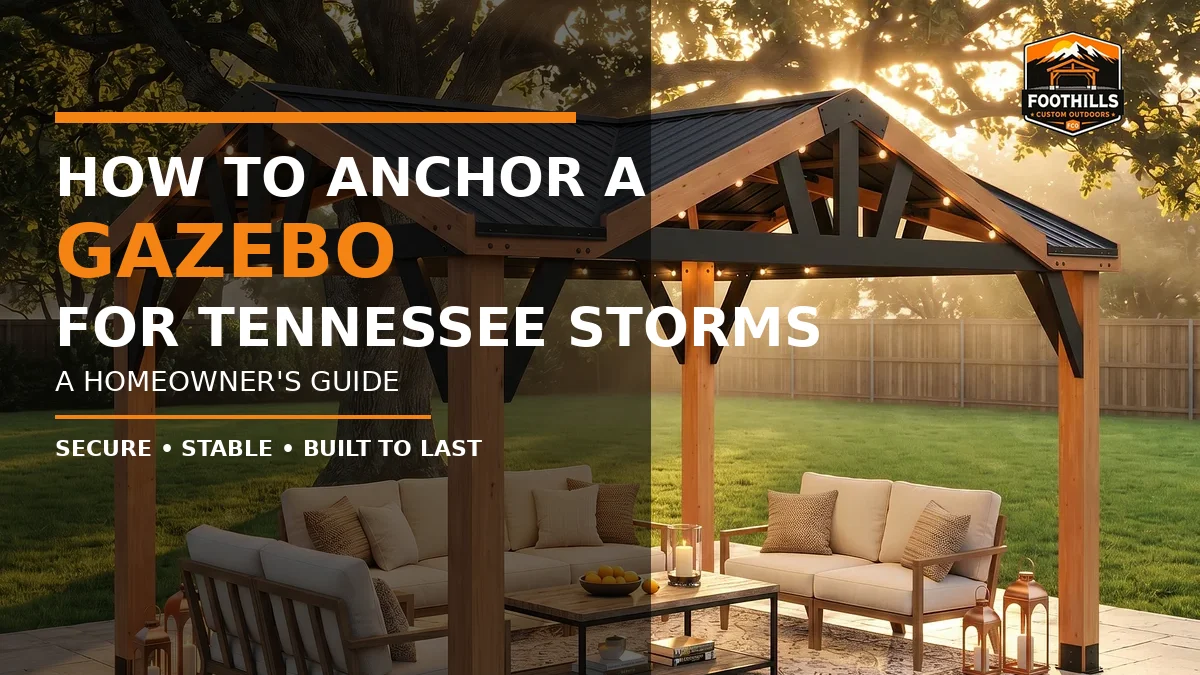
How to Anchor a Gazebo for Tennessee Storms: A Homeowner’s Guide
A gazebo in Tennessee is not a decoration. It is a 400-to-900-pound wind-catching structure sitting in a yard that sees straight-line thunderstorm gusts of 55 to 70 miles per hour several times every summer and severe events reaching 70 to 90 miles per hour every 3 to 5 years. The decisive factor between a gazebo that stands tall for 20 years and a gazebo that becomes a liability in year three is the anchoring. Not the roof style. Not the material. Not the price. The anchoring.
Yet anchoring is also the single most under-executed phase in both DIY installations and the cheapest professional installs. Homeowners drive four stakes into the ground, call it done, and move on. Then a July thunderstorm rolls through, and the gazebo either shifts, racks out of square, lifts partially off the pad, or in the worst cases becomes airborne.
This guide fixes that. The actual wind physics a Knoxville-area gazebo faces. The six anchoring methods ranked by what they handle. Foundation options matched to real East Tennessee soil conditions. How anchoring changes on sloped foothill lots common in Blount and Sevier counties. The specific hardware, torque, and depth specifications that matter. DIY-versus-professional math for anchoring work specifically. Common mistakes that undo even well-intentioned installations. And a complete maintenance checklist to keep the anchoring effective year after year.
If you are shopping gazebo installation in the Knoxville area or you already own one and want to confirm it is actually anchored properly for this region’s storm profile, this guide is the technical reference you need.
Will a Gazebo Blow Away in Strong Wind?
Yes, absolutely. The exact threshold depends on four factors: the gazebo’s weight, its surface area catching wind, the anchoring system holding it down, and the actual wind speed.
The Wind Math
Wind pressure on a vertical surface roughly doubles when wind speed increases by 40 percent. A gazebo that handles a 40 mile per hour gust comfortably starts experiencing meaningful stress at 55 mph, significant stress at 65 mph, and genuine lifting force at 75 mph and above. The forces are not linear; they are approximately quadratic.
A typical 12×12 hardtop gazebo in Knoxville presents roughly 60 to 90 square feet of effective wind-catching surface (combining the roof underside, the walls, and the structural members). At 65 mph gust speeds, the uplift and lateral forces on that surface can approach 500 to 900 pounds depending on the roof design and the wind angle.
A 400-pound unanchored gazebo loses that fight.
A 400-pound gazebo properly anchored with four engineered concrete anchors, each rated for 500-plus pounds of pullout resistance, wins that fight comfortably.
The Knoxville Wind Reality
The National Weather Service tracks severe weather events across East Tennessee. The patterns relevant to any gazebo installation here:
- Routine summer thunderstorms bring gusts of 40 to 55 mph several times per month during peak season (May through September).
- Severe thunderstorm warnings are issued multiple times each summer for Knox, Blount, Loudon, and Sevier counties with gusts commonly reaching 55 to 70 mph.
- Straight-line wind events every 1 to 3 years bring sustained gusts of 70 to 85 mph across parts of the Knoxville metro.
- Tornado-associated winds during significant severe weather events can exceed 100 mph in localized areas, though these are rare and typically brief.
- Winter wind events are generally milder in Knoxville than summer thunderstorms, though cold-front passages can bring 50 to 60 mph gusts.
Any gazebo in the Knoxville area needs to handle at least 70 mph gusts reliably and ideally carry margin to 85 mph. Below those thresholds, the gazebo is a problem waiting for the right summer afternoon.
Why Anchoring Matters More Here Than in Other Markets
East Tennessee has three characteristics that make anchoring more critical than in many other regions.
Thunderstorm frequency: Knoxville sees 50 to 60 thunderstorm days per year, well above the national average. Each one is a stress test for every outdoor structure in the yard.
Clay soil behavior: Much of the Knoxville area sits on clay soil that shrinks in summer and swells with winter moisture. This movement loosens surface-driven ground anchors over time, which is why permanent concrete footer anchoring is preferred to driven stakes for anything intended to last more than a few years.
Freeze-thaw cycles: Knoxville averages 40 to 50 overnight freezes per year. Concrete footers need to extend below the frost line (typically 12 inches in this area) to avoid frost heave that cracks concrete and loosens anchor bolts.
Foothill terrain: Sloped lots common in Blount, Sevier, and eastern Knox counties create wind-channeling effects along ridges, hollows, and valleys. The wind at your foothill house may be meaningfully higher than the regional average on severe weather days.
Those four factors together are why a casual approach to gazebo anchoring, which may work fine in flat suburban Michigan or coastal Florida, fails faster in East Tennessee.
What Base Is Best for Gazebo Installation?
The right foundation depends on the gazebo type, the soil conditions, the slope, and the long-term plan for the structure. Six foundation options cover roughly 95 percent of Knoxville-area gazebo installations.
Option 1: Poured Concrete Slab
Cost in Knoxville: $1,800 to $4,500 for a 12×12 slab installed.
When it works best: permanent installations, premium gazebos, long-term plans, exposed foothill sites.
Why it is the gold standard: a 4-inch reinforced concrete slab provides a level surface, prevents frost heave with proper depth and base preparation, allows concrete-anchor bolts to be set directly into the slab, and lasts the life of the gazebo. For most quality gazebo installations in East Tennessee, the slab is the right choice unless the yard or budget specifically favors another approach.
Depth specification: 4-inch minimum thickness, with a 4 to 6 inch compacted gravel base below. Reinforced with rebar or welded wire mesh. Edges thickened to 8 to 12 inches to resist frost penetration at the perimeter.
Option 2: Concrete Footers (Per Post)
Cost in Knoxville: $800 to $1,800 for 4 corner footers installed.
When it works best: wood gazebos with distinct corner posts, cost-conscious permanent installs, sites where a full slab is not practical.
Why it works: individual concrete footers at each corner post provide dedicated anchor points for lag bolts or anchor straps. The pergola or gazebo frame rests on top of the footers (or spans between them with a wood deck), and the structure anchors into each footer independently.
Depth specification: 12 inches minimum depth (frost line), 10 to 12 inches diameter, with the top either flush with ground level or protruding 2 to 4 inches depending on the attachment hardware.
Option 3: Compacted Gravel Pad with Separate Anchors
Cost in Knoxville: $600 to $1,800 for the gravel pad plus $400 to $900 for engineered anchors.
When it works best: mid-range gazebos, moderate wind exposure, aesthetic preference for a natural look.
Important caveat: compacted gravel on its own does not anchor a gazebo. The gravel provides a stable, level, drainable surface, but the anchoring must come from either concrete footers hidden under the gravel at each corner or engineered ground anchors driven deep into the subsoil through the gravel. Once you add the footers to a gravel pad, the total cost often approaches a full concrete slab anyway, which is why many installers recommend the slab for better long-term outcome.
Option 4: Paver or Flagstone Patio
Cost in Knoxville: $2,500 to $5,500 for a 12×12 paver patio installed.
When it works best: installations where the gazebo is part of a broader hardscape design, aesthetic-driven projects, premium installations.
Important caveat: pavers on their own do not anchor a gazebo any more than gravel does. Anchoring must come from concrete footers set beneath the pavers at each corner post location or engineered anchors driven through the paver base into subsoil. Factor these in separately from the paver cost.
Option 5: Existing Deck Attachment
Cost in Knoxville: $300 to $1,200 for professional attachment labor.
When it works best: installations where a sound existing deck is already in place.
Requirements: the existing deck must be structurally rated to carry the additional load of the gazebo plus occupants plus wind load. Many older residential decks were not engineered for this additional load, and attaching a gazebo without reinforcement can compromise the deck structure. A structural evaluation before attachment is strongly recommended. Attachment hardware includes through-bolted lag connections or specialized deck-mount brackets designed for permanent structure attachment.
Option 6: Ground Anchor Only (No Foundation)
Cost in Knoxville: $150 to $600 for anchor hardware.
When it works best: compact lightweight gazebos (soft-top canopies, small aluminum frames) on firm level ground in protected sites.
Honest assessment for East Tennessee: this is not adequate anchoring for any permanent gazebo. Soft-top canopy gazebos and the smallest aluminum frame gazebos (under 10×10) may be acceptable with aggressive ground anchoring, but this approach is not sufficient for the heavier wood gazebos and premium aluminum gazebos common in the Foothills Custom Outdoors product lineup. The gazebos collection represents builds that benefit meaningfully from concrete footer or slab foundations rather than surface anchoring alone.
The Six Anchoring Methods Ranked
Not all anchoring is equal. Here is the honest ranking of anchoring methods by how well they actually hold up in Tennessee storm conditions.
Method 1 (Strongest): Concrete Anchor Bolts Set in Slab
Pullout resistance per anchor: 1,500 to 4,000 pounds depending on bolt size and embed depth.
Installation: 1/2-inch to 5/8-inch diameter anchor bolts (wedge-style expansion anchors or epoxy-set threaded rods) drilled into cured concrete slab at each post location, embed depth typically 3 to 4 inches, torqued to manufacturer specification.
Best for: permanent wood gazebos, premium aluminum gazebos, any installation on an existing or new slab.
Why it tops the ranking: cured concrete plus properly set expansion anchors provides the highest pullout resistance of any residential anchoring method. The anchor bolts transfer wind loads directly into the mass of the slab, which cannot easily be dislodged.
Method 2: Concrete Footers with Through-Bolted Lag Connections
Pullout resistance per anchor: 1,200 to 3,000 pounds depending on bolt specification and footer size.
Installation: individual concrete footers at each corner post, through-bolted lag connections or anchor straps embedded in the wet concrete during pour, structural fasteners securing the post to the footer.
Best for: wood gazebos on sites where a full slab is not practical, mid-range builds, cost-conscious permanent installs.
Why it ranks high: nearly as strong as full-slab anchoring, meaningfully cheaper, and provides excellent long-term performance in East Tennessee conditions.
Method 3: Engineered Ground Anchor Augers
Pullout resistance per anchor: 1,000 to 2,500 pounds depending on auger size and soil type.
Installation: large-diameter screw-in augers driven 3 to 5 feet into subsoil, with cable or threaded-rod connections to the gazebo frame. Multiple augers per corner for larger structures.
Best for: sites where concrete work is impractical (rocky ground, root-filled yards, aesthetic constraints), premium kit gazebos designed for auger anchoring, exposed sites in foothill locations.
Why it ranks here: engineered augers deliver real holding power without concrete, but installation requires either specialized equipment or significant physical effort. Pullout resistance depends heavily on soil conditions; sandy or rocky soil reduces effectiveness.
Method 4: Manufacturer-Supplied Ground Stakes
Pullout resistance per anchor: 150 to 600 pounds depending on stake length and soil.
Installation: steel stakes 18 to 36 inches long driven into the ground at each corner, with straps or cables connecting to the gazebo frame.
Best for: entry-level kit gazebos, aluminum frame structures under 10×10, temporary installations.
Why it ranks middle: adequate for mild wind and small structures but not sufficient for serious Tennessee storms on larger gazebos. Most gazebos installed by Foothills Custom Outdoors benefit from upgrading beyond the included stakes.
Method 5: Weight-Based Anchoring (Sandbags, Concrete Blocks)
Resistance per anchor: depends entirely on the weight used; typical sandbag or block installations provide 50 to 300 pounds of downward resistance per corner.
Installation: sandbags or concrete blocks placed at each corner of the gazebo, often inside base plates or decorative skirting.
Best for: temporary installations, rental gazebos, pop-up canopies.
Why it ranks low for permanent installations: weight-based anchoring resists uplift only as long as the weights outweigh the uplift force. In a serious thunderstorm, 200 pounds of sandbags per corner is simply not enough to resist 500 pounds of uplift per corner.
Method 6 (Weakest): Guy Ropes and Tie-Downs to External Objects
Resistance per anchor: varies widely with the anchor point, typically 100 to 500 pounds.
Installation: ropes or straps running from the gazebo frame to trees, fences, or ground stakes placed away from the structure.
Best for: temporary camping-style gazebos, event tents, short-term installations.
Why it ranks last for permanent installations: guy ropes can supplement other anchoring but should not be the primary method for a permanent gazebo. The failure mode is unpredictable: ropes stretch, slip, or break, and anchor points (trees, fences) can move or fail themselves.
How Is a Gazebo Anchored on a Sloped Yard?
Sloped lots are common across much of the Knoxville area, especially in Blount, Sevier, and the eastern reaches of Knox County. Standard anchoring approaches do not translate directly to sloped sites. Four approaches work.
Approach 1: Level the Install Area First
Cut and fill, or build up a leveled pad, to create a level base before any anchoring work begins. This is often the right answer because it simplifies every subsequent step: foundation, anchoring, and the gazebo itself all go in on a stable level surface.
Cost impact: $500 to $3,500 depending on slope severity and site conditions. On modest slopes, minor regrading is sufficient. On steeper slopes, meaningful earthwork is required.
Approach 2: Build a Retaining Wall and Level Pad
For significant slopes, a short retaining wall on the downhill side creates a flat pad for the gazebo. The wall holds back the uphill soil and provides a defined edge for the install area.
Cost impact: $1,500 to $8,000 depending on wall height and material.
Approach 3: Variable-Depth Concrete Footers
Keep the gazebo frame level while allowing the footers underneath to be different depths. The uphill footers may be shallower (still at frost line); the downhill footers deeper, with the exposed concrete clad in stone veneer or buried under landscaping.
Cost impact: $200 to $800 above the cost of flat-site footers.
Approach 4: Raised Deck Platform
Build a wood deck platform on posts that reach down to level footings, then place the gazebo on the leveled deck surface. Common for homes where the gazebo wraps around a slope or steps down from a main deck.
Cost impact: $2,500 to $12,000 depending on deck size and height.
For most Knoxville-area sloped-site installations, Approach 1 (leveling the install area) combined with concrete footer anchoring is the right choice. It handles the slope decisively, delivers strong anchoring, and avoids the ongoing complexity of variable-depth footers.
A conversation about site preparation and foundation work at the quote stage is particularly worthwhile for sloped yards; the right approach depends on grade severity, soil conditions, drainage patterns, and the specific gazebo being installed.
Hardware Specification: What Actually Works
Anchoring hardware is where cheap installations and quality installations show the most meaningful difference. Here is what to specify.
Anchor Bolts for Concrete
- Diameter: 1/2 inch minimum for compact gazebos, 5/8 inch for standard installations, 3/4 inch for premium larger structures
- Type: wedge-style expansion anchors or epoxy-set threaded rods (both acceptable; wedge anchors are faster to install, epoxy is slightly stronger)
- Embed depth: 3 inches minimum for 1/2-inch bolts, 4 inches for 5/8-inch, 5 inches for 3/4-inch
- Finish: galvanized or stainless steel; plain carbon steel will rust in the Knoxville humidity profile within 2 to 3 years
- Torque: per manufacturer specification, typically 25 to 50 foot-pounds depending on bolt size
Lag Bolts for Wood-to-Footer Connections
- Diameter: 1/2 inch minimum, 5/8 inch for larger structures
- Length: at least 3 inches of embed into the post plus full embed through the hardware
- Finish: galvanized or stainless; the carbon steel versions sold at box stores are not adequate for permanent outdoor installations in this climate
- Washers: structural washers (thicker than standard flat washers) sized to the bolt
Ground Anchor Augers
- Diameter: 3 inch minimum, 6 inch preferred for premium installations
- Length: 36 to 60 inches of embed into subsoil below the surface
- Finish: galvanized or hot-dip zinc
- Hardware: matched cable or threaded rod connections sized to the auger specification
Driven Stakes (Lower-End Applications Only)
- Length: 24 inches minimum, 36 inches preferred for Tennessee wind conditions
- Diameter: 1/2 inch minimum
- Finish: galvanized
- Angle: driven at a 10 to 15 degree angle away from the gazebo to improve pullout resistance
For any installation handled through Foothills Custom Outdoors, the specific hardware specification is confirmed as part of the quote and reflects the engineering for your specific site. The companion anchoring and wind protection engineering service covers how site conditions drive the hardware choice.
DIY vs. Professional Anchoring
Anchoring is one of the phases where DIY and professional installation diverge most sharply in actual quality outcome.
DIY Anchoring Reality
A handy homeowner can install anchor bolts in an existing concrete slab, pour and set concrete footers, and attach a gazebo frame to prepared anchor points. The tools required are not extreme: a hammer drill, a torque wrench, a level, concrete mix, and basic hand tools.
Where DIY anchoring typically falls short:
- Anchor depth and quantity undersized for actual wind loads
- Hardware specification cheaper than engineering actually requires
- Hole drilling that cracks the concrete slab (needs correct bit speed and water cooling)
- Torque not applied to specification (relying on “tight enough”)
- Insufficient pullout testing after installation
- Skipping the site evaluation that would reveal the specific anchoring approach needed
- Missing the inspection step that catches installation errors before they become problems
DIY cost advantage: $400 to $1,200 saved versus professional anchoring labor.
Professional Anchoring Reality
A professional crew brings site-specific engineering judgment, proper hardware, calibrated torque tools, and the installation experience to catch issues before they become failures. The gazebo installation and assembly service at Foothills Custom Outdoors handles anchoring as a specification-driven phase rather than a general-purpose task.
Professional anchoring includes:
- Site evaluation determining the right anchoring approach for your specific location
- Hardware specification matched to the gazebo and the wind exposure
- Proper installation with calibrated torque
- Pullout testing after installation
- Documentation supporting any future warranty claims
- Workmanship warranty on the anchoring work itself
Honest verdict: anchoring is the phase where DIY corner-cutting shows up most consequentially. A gazebo that looks fine on day one but was under-anchored can fail suddenly years later, with limited warning. For permanent gazebo installations in East Tennessee, professional anchoring is the honest choice. For homeowners committed to the DIY route, over-specify every component: use the next size up on bolts, go deeper on footer depth, add more anchor points than the minimum, and verify every installation with a pullout test.
Seven Common Anchoring Mistakes to Avoid
The failure modes that show up most often in East Tennessee gazebo installations:
1. Treating stakes as adequate anchoring for a permanent structure: Manufacturer-supplied stakes are rated for routine wind, not Tennessee storms. Any gazebo intended to last 15 to 20 years needs stronger anchoring.
2. Using plain-steel hardware in the humid Knoxville climate: Carbon-steel bolts, washers, and anchors rust within 2 to 3 years in East Tennessee humidity. Galvanized or stainless steel is the correct specification.
3. Setting concrete footers above the frost line: Shallow footers (less than 12 inches deep) are subject to frost heave in Knoxville winters. The footer cracks, the anchor shifts, and the gazebo develops wobble.
4. Drilling anchor bolt holes in freshly poured concrete: Concrete needs to cure fully (typically 28 days) before expansion anchors can be installed reliably. Drilling into partially cured concrete can crack the slab or compromise the anchor hold.
5. Underestimating wind loads based on average conditions: The average Knoxville summer day is calm. The decisive conditions are the thunderstorm events that happen several times per month during peak season. Design the anchoring for the worst case, not the average.
6. Skipping the pullout test: After installation, every anchor should be stress-tested by applying meaningful pulling force to confirm it holds. Anchors that pull out under moderate force need to be redone before the gazebo is handed over.
7. Failing to maintain the anchoring over time: Hardware loosens with thermal cycling, soil movement, and routine use. An annual check that re-torques fasteners and inspects for corrosion keeps the anchoring effective for the full life of the gazebo.
Anchoring on Different Surfaces: Specific Techniques
Different base surfaces require different anchoring approaches.
Concrete Slab
Pre-drill holes at each post location using a hammer drill and a carbide-tipped masonry bit sized to the anchor bolt diameter. Clean out dust with a vacuum. Insert wedge anchors or set epoxy threaded rods. Allow epoxy to cure if used. Set the gazebo frame over the anchor bolts and torque fasteners to specification.
Concrete Footers (Separate Per Post)
Install anchor straps or threaded rod anchors into the wet concrete during the pour. Allow 28 days cure before applying structural load. Fit the gazebo posts over or around the embedded hardware, then bolt the connection.
Wood Deck
Verify the deck can carry the gazebo load structurally. Use through-deck lag bolts into joists (not just the deck boards) with structural washers on both sides. Preferably reinforce the attachment with additional joist blocking below each gazebo post. If the deck is older or structurally questionable, do not attach without engineering evaluation.
Pavers Over Compacted Base
Pavers alone do not anchor the gazebo. Drill through pavers into concrete footers set beneath, or install engineered augers that reach undisturbed subsoil below the paver base. Confirm anchor pullout strength matches the gazebo wind-load requirements.
Grass or Soil (Semi-Permanent Only)
Drive engineered augers 3 to 5 feet into firm subsoil at each corner. Attach the gazebo frame to the auger tops via cable or threaded rod. This approach is adequate for mid-size kit gazebos in protected sites but is not the right choice for larger premium builds.
Rocky Ground
Common on ridge lots and foothill properties in East Tennessee. Standard anchoring may not reach adequate depth. Options: core-drill through surface rock to deeper soil, install surface-mounted concrete pads with structural anchors tied back to rebar driven horizontally into the rock, or redesign the install location to a different section of the yard. Site evaluation is essential before ordering a gazebo for rocky sites.
Maintenance to Keep Anchoring Effective
Anchoring is not a one-time job. Here is the maintenance schedule that keeps a Knoxville-area gazebo securely anchored for its full life.
Annual spring inspection:
- Visually check all anchor bolts and fasteners for corrosion
- Torque every bolt back to specification (hardware loosens through thermal cycling)
- Inspect concrete footers or slab for cracks, especially at corners
- Check for soil erosion or settling around footer bases
- Confirm no roots or burrowing animals have disturbed anchor points
- Verify no visible frost-heave movement from the previous winter
After every severe weather event:
- Walk the gazebo, pushing on each corner post to feel for new give
- Visually inspect the anchor hardware for any shifting or damage
- Check for roof fastener loosening (storms stress every connection, not just the anchors)
- Document any observed issues with photos
- Contact your installer for professional reinspection if anything looks compromised
Every 3 to 5 years:
- Replace any corroding fasteners proactively rather than waiting for failure
- Reseal exposed concrete footer tops to prevent water infiltration into the anchor connection
- Reconfirm the overall structural integrity of the installation
Foothills Custom Outdoors includes workmanship warranty coverage on the anchoring work itself as part of every standard installation, with documentation that supports future warranty claims if issues develop. More context on the warranty coverage and service approach is on the warranty information page.
Gazebo Anchoring and Related Structure Decisions
If you are still working through the choice between a gazebo, pergola, or pavilion for your yard before you get to anchoring specifics, the pergola vs gazebo comparison guide for Knoxville backyards walks through the structure-type decision at length. For homeowners already committed to a gazebo and looking at the full installed cost picture, the companion gazebo installation cost in Knoxville guide covers the pricing side including anchoring premiums.
For gazebos built to serve as outdoor cook spaces specifically, the grill gazebos and bars collection represents purpose-built structures that often benefit from upgraded anchoring given the appliance loads and the frequency of use.
Frequently Asked Questions
Will a gazebo really blow away in Tennessee wind?
Yes, if it is unanchored or under-anchored. Routine Knoxville summer thunderstorms bring 55 to 70 mph gusts, and severe weather events every few years can exceed 85 mph. A typical 400-pound unanchored gazebo cannot resist the uplift force from a 65 mph gust against its roof surface. Proper concrete anchoring at each corner prevents this failure mode entirely; weight-based or stake-based anchoring may not.
What base is best for gazebo installation in Knoxville?
For permanent installations, a poured concrete slab is the strongest option. For cost-conscious permanent installs, individual concrete footers at each post deliver nearly equivalent performance at lower cost. Compacted gravel pads alone are not adequate anchoring; they require separate concrete footers or engineered anchors underneath. The exact choice depends on gazebo size, site slope, soil conditions, and long-term plans.
How is a gazebo anchored on a sloped yard?
Four approaches work in East Tennessee. Level the install area with cut-and-fill before anchoring; build a short retaining wall to create a flat pad; use variable-depth concrete footers that keep the frame level while the concrete depths vary; or build a raised deck platform. For most Knoxville-area sloped sites, leveling the install area combined with concrete footer anchoring delivers the cleanest long-term outcome.
How much wind can a well-anchored gazebo withstand?
A properly anchored gazebo (concrete slab or footer anchoring with correct hardware specification) handles 70 to 90 mph gusts routinely and 100 mph gusts in exceptional conditions. The exact threshold depends on the gazebo manufacturer’s wind rating combined with the anchoring installation. In the Knoxville area, aim for anchoring that carries meaningful margin above the 70 to 85 mph gust events that happen every few summers.
Do I need a permit for gazebo anchoring work in Knoxville?
Permit requirements apply to the gazebo structure itself rather than the anchoring specifically. Freestanding gazebos under 200 square feet without permanent utility connections may qualify for exempt or simplified permitting in Knox County and the City of Knoxville. Larger gazebos typically require a permit that includes foundation and anchoring review. HOA architectural approval is also required in stricter subdivisions regardless of permit status.
Can I anchor a gazebo myself?
Yes, with proper tools and specification. The challenge is not the physical work but the engineering judgment: knowing the right hardware size, embed depth, anchor count, and installation approach for your specific site. DIY anchoring frequently falls short on specification rather than execution. For permanent installations, professional anchoring is generally the better choice; for homeowners committed to DIY, over-specify every component.
What is the lifespan of concrete footer anchoring?
30 to 50 years if properly installed. Concrete footers below the frost line with galvanized or stainless hardware installed correctly outlast most residential structures. The anchoring itself is not typically the first failure point; the gazebo frame or roof covering usually ages faster than well-executed concrete anchoring.
Do I need to add weights to my gazebo if it is already bolted to concrete?
No. Weight-based anchoring (sandbags, concrete blocks) is only needed when a permanent anchoring method is not practical. A gazebo properly bolted to a concrete slab or concrete footers does not need supplemental weights.
How often should I check my gazebo anchoring?
Annual spring inspections cover routine maintenance (torque check, corrosion inspection, settling assessment). Post-storm checks after any severe weather event confirm nothing shifted. Every 3 to 5 years, replace any corroding hardware proactively. The schedule in the maintenance section above is the complete recommended cadence.
My gazebo wobbles slightly. Is that normal?
No. A properly anchored gazebo should not wobble, rock, or move when pushed. Any visible movement indicates anchoring that needs attention. Check for loose bolts first (annual torque is often sufficient to resolve mild wobble). If the structure still wobbles after bolt torquing, contact your installer for inspection; the underlying anchoring may need upgrading.
Can an existing gazebo be re-anchored if the original anchoring was inadequate?
Yes, in most cases. The gazebo frame can be lifted temporarily, new concrete footers or slab anchors installed, and the gazebo reset on the upgraded foundation. Cost depends on the complexity but typically runs $800 to $3,500 for a mid-size gazebo. This is often the right investment for homeowners who inherited an under-anchored structure with a previous home or who DIY’d an installation that is now showing wobble or movement.
What about anchoring for the grill gazebos and outdoor bars?
Same principles as regular gazebos, with upgraded anchoring recommended because the structures often support meaningful appliance weight and see higher-frequency use. Concrete slab anchoring is typically the right choice for grill gazebo and outdoor bar installations given the overall project investment.
Making the Right Anchoring Decision
The anchoring is not where to save money on a gazebo installation. Every other cost in the project (the gazebo itself, the roof, the finish work, the lighting, the furnishings) protects the investment only as long as the structure stays grounded.
In East Tennessee, that means designing the anchoring against the real wind profile, not the hypothetical calm day. Concrete footers below frost line, galvanized or stainless hardware, correct torque specifications, pullout testing after installation, and annual maintenance to keep everything tight.
For most Knoxville-area homeowners installing a permanent gazebo, professional installation with engineered anchoring is the honest recommendation. The direct cost premium versus DIY runs $400 to $1,200 on the anchoring phase specifically, and that premium buys engineering judgment, hardware specification, proper installation, and warranty-backed workmanship that cannot be replicated by a homeowner installing their first gazebo.
A properly anchored gazebo stands tall through 20 years of Tennessee summer storms, winter freezes, and every ordinary afternoon in between. An under-anchored one is a slow-motion problem that announces itself unpredictably on the wrong storm day. The difference between those two outcomes is almost entirely in the anchoring work. Get it right the first time.