Best Gazebo Materials for Tennessee Humidity: Cedar, Metal, or Vinyl?
A gazebo that looks great on delivery day and holds up for 20 years in East Tennessee is a different structure than one that survives a mild desert climate. Our summers push 90 degrees with 70-plus percent humidity for weeks at a stretch. Our thunderstorms roll in fast and hard. Our pollen season coats everything in yellow-green. Our winters flirt with freezing but rarely commit. All of that changes what materials actually work, and it’s why generic “best gazebo material” advice from national outdoor retailers so often disappoints Knoxville homeowners a few years down the road. This guide walks through cedar, metal, vinyl, and the material combinations that actually earn their keep in East Tennessee humidity, from a gazebo builder that installs them here every season.
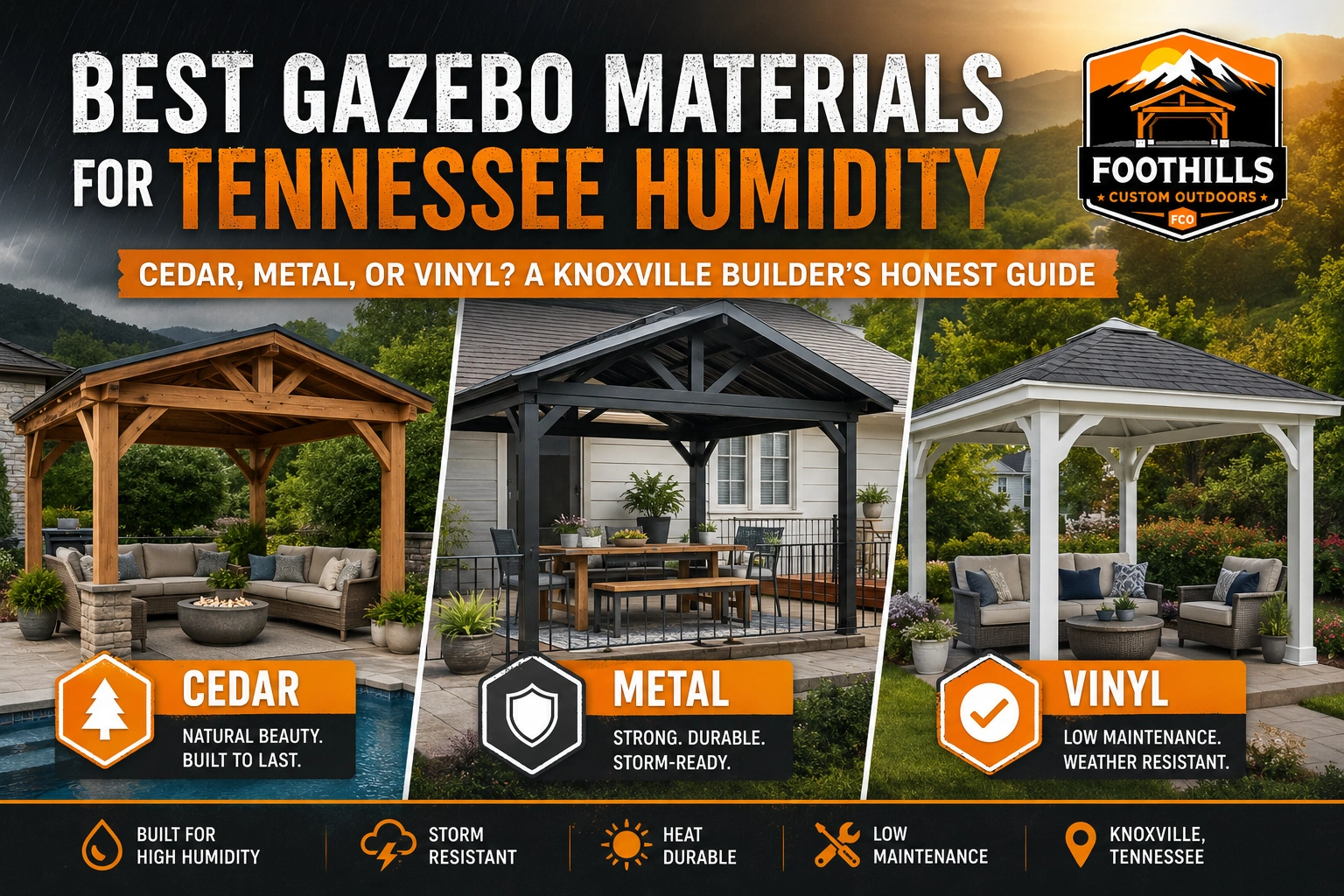
The short answer: for most Knoxville-area homes, a cedar frame with a metal hardtop roof is the best all-around combination for our humidity, storms, and summer heat. Powder-coated aluminum with a polycarbonate roof is the runner-up and the right pick if you want the lowest-maintenance option. Vinyl works for specific use cases but is rarely our top recommendation. And pressure-treated pine, the material you’ll see in the cheapest big-box kits, is almost never the right call for a structure meant to last more than a decade in East Tennessee weather.
What Tennessee Humidity Actually Does to Outdoor Structures
To pick the right material, it helps to know exactly what you’re picking against. Knoxville’s climate has four specific characteristics that punish outdoor structures.
Sustained summer humidity: From May through September, relative humidity averages 65 to 80 percent, with periods above 85 percent common. That constant moisture load drives every failure mode outdoor structures have: wood rot, metal corrosion, mold and mildew growth, and adhesive breakdown on fabric canopies. Materials that survive dry summers can fail in Tennessee ones.
Freeze-thaw cycles: Winter temperatures in Knox County typically bounce between the 20s and the 50s, sometimes on the same day. Water that seeps into a hairline crack in wood or a coating flaw on metal expands as it freezes, opening the crack wider. Over a decade of this, small flaws become structural problems.
Fast-moving thunderstorms: Straight-line winds during summer thunderstorms regularly hit 40 to 60 mph in East Tennessee, and severe storm events can push higher. This is why anchoring matters, but it’s also why fabric canopies and lightweight structures don’t age well here.
High pollen and tree debris: Knoxville is one of the highest-pollen cities in the country every spring, and the mix of oak, maple, and pine debris that accumulates on gazebo roofs holds moisture against the surface. This accelerates staining on wood shingles, growth of moss and mildew, and corrosion on metal.
UV intensity: East Tennessee gets serious sun exposure from May through August. UV degrades unprotected wood, breaks down cheap plastics, and fades painted or stained finishes.
The materials that hold up in this environment are the ones designed to handle all of the above at once – not just one of them.
Cedar: The East Tennessee Standard
Cedar is the wood we install more of than any other in Knoxville-area gazebos, and it’s the material we recommend most often. Here’s the honest picture.
Why cedar works: Cedar’s natural oils give it real resistance to rot, insects, and moisture absorption. It doesn’t warp as aggressively as pine when humidity swings, and it handles freeze-thaw cycles well. Western Red Cedar is the specific species that dominates the residential gazebo market and the one most quality kit manufacturers use. Cedar also provides genuine thermal comfort – a cedar-framed gazebo with a wood-shake or metal roof feels noticeably cooler underneath than a metal-framed structure sitting in the same July sun.
The aesthetic case: Cedar has warmth that metal and vinyl just don’t. It ages into a silvery patina if left untreated, or holds a rich brown tone if sealed regularly. It blends into East Tennessee’s natural landscape – the wooded lots common across Knox County, Blount County, Sevier County, and up into the Great Smoky foothills. A metal gazebo can look industrial in that setting. A cedar gazebo looks native.
What cedar demands: Cedar isn’t maintenance-free. Left untreated, it silvers naturally and holds up structurally for 15 to 25 years, but the wood surface roughens and can develop small surface checks. If you want it to keep its warm brown tone, you need to seal or stain it every one to three years. In Knoxville humidity, that’s a real Saturday project every couple of years, or a service line item if you’re not doing it yourself. Our ongoing maintenance services cover this for homeowners who want the look without the labor.
Where cedar struggles: Cedar at direct ground contact rots. This is why quality cedar gazebo installations always sit on a raised foundation – a slab, paver base, or gravel pad with proper drainage – rather than directly on soil. Cedar in dense shade with poor airflow also grows mildew faster than the same wood in open sun. Placement matters as much as material.
Cedar cost range: A quality 10×12 cedar hardtop gazebo kit runs $2,500 to $5,500. A 12×14 runs $3,500 to $7,000. A 14×14 to 16×20 wood pavilion typically ranges from $5,500 to $12,000+ for the structure itself. Installation adds another 20 to 40 percent of the kit cost. For a full look at what to expect on installation cost specifically, see our companion piece on gazebo installation cost in Knoxville.
Powder-Coated Aluminum and Galvanized Steel: The Low-Maintenance Winners
Metal-framed hardtop gazebos have taken over a significant share of the East Tennessee market in the last five years, and there are good reasons for that. Here’s what to know.
Why aluminum works: Powder-coated aluminum won’t rust because it can’t – aluminum doesn’t oxidize the way iron does. In Tennessee humidity, that’s a real advantage. Aluminum frames don’t rot, don’t warp, don’t need sealing, and require essentially no annual maintenance beyond an occasional wash-down. The powder coating protects against surface wear and UV. A quality aluminum gazebo can hold up structurally for 20+ years with minimal attention.
Why steel works too: Galvanized steel is stronger than aluminum, which matters if you’re anywhere with meaningful wind exposure or want the option to hang a ceiling fan or heavier lighting from the structure. The galvanization (usually a hot-dip zinc coating) protects the steel from rust in humid environments. Powder coating over galvanized steel is the ideal combination for East Tennessee – the zinc handles corrosion, the powder coat handles UV and cosmetics.
Where metal struggles: Two real trade-offs. First, metal absorbs and radiates heat. A metal-framed, metal-roofed gazebo in direct July sun in Knoxville feels warmer underneath than a wood-framed one, even with the same footprint. A ceiling fan and light-colored roof panels help, but this is a real consideration for anyone planning to use the gazebo for hot afternoons. Second, metal doesn’t blend into a wooded East Tennessee lot the way cedar does. If your yard borders a natural area or you want a structure that looks like it belongs, metal reads more contemporary. This isn’t a problem – it’s an aesthetic choice.
Rust risk on metal frames: Any metal exposed to Tennessee humidity will eventually rust if the coating fails. This is why powder coating quality matters. Cheap import gazebos with thin coating develop rust spots within a few seasons. Quality gazebos from established brands with proper galvanization and powder coating hold up for decades. When comparing metal gazebos, check the coating spec, not just the price.
Metal cost range: A 10×12 metal hardtop gazebo runs $1,200 to $3,500 for the kit. A 12×14 runs $2,000 to $5,000. Larger metal-framed structures scale from there. Installation is faster than wood – the components are lighter and more standardized – which usually means metal gazebos install for 20 to 30 percent less labor than an equivalent-size wood structure.
Vinyl: Low Maintenance With Real Trade-Offs
Vinyl gazebos are marketed as the ultimate low-maintenance option, and there’s truth to that. Here’s the full picture.
Why vinyl appeals: Vinyl doesn’t rot, doesn’t rust, doesn’t need sealing, and washes off with a hose. In humidity, that’s genuinely useful. Vinyl also holds a bright white finish (or other colors) consistently for a long time, without the fading you get with painted wood. For homeowners who genuinely never want to think about their gazebo again, vinyl delivers.
How vinyl actually holds up in East Tennessee: Quality vinyl gazebos have a treated pine or aluminum core wrapped in a heavy vinyl sleeve. The sleeve handles UV, moisture, and cosmetics; the core provides structure. Well-built vinyl holds up for 20 to 30 years in Tennessee humidity with virtually no maintenance. Poorly built vinyl – the cheaper imports where the sleeve is thin – can yellow, chalk, or become brittle in UV exposure within 5 to 10 years. Brand quality matters more with vinyl than with cedar or metal.
Where vinyl struggles: Aesthetics is the main one. Vinyl gazebos look like vinyl gazebos. They don’t age with character the way cedar does; they either stay looking clean or start looking obviously plastic. On formal homes and modern properties, they fit in. On rustic lots or wooded backyards, they can feel out of place. Vinyl is also difficult to repair if damaged. A cracked cedar beam can be replaced by a carpenter. A cracked vinyl panel usually needs a full component from the manufacturer, which may or may not still be available.
Cost range: Vinyl is typically the most expensive kit option for a given size. A 10×12 vinyl gazebo kit runs $4,500 to $8,500. A 12×14 runs $6,500 to $11,000. Installation costs are similar to comparable-size wood structures.
When vinyl is the right pick: Homeowners who prioritize low maintenance above everything else, who want a bright clean look that stays consistent, and whose home architecture matches the more formal look of vinyl. It’s a fine option in those situations. For most East Tennessee homes on wooded or rural lots, we usually recommend cedar or metal first.
Pressure-Treated Pine: Cheaper Up Front, Almost Never Worth It
Pressure-treated pine (specifically Southern Yellow Pine) is the material behind most of the cheap gazebo kits and lumber-yard DIY plans. Here’s the honest take.
Why it exists: Pressure treatment injects preservatives into pine wood to resist rot and insects. Done properly, it substantially extends the wood’s lifespan compared to untreated pine.
Why it usually disappoints: Even properly treated pine in East Tennessee humidity tends to check, split, and cup as it dries. It requires aggressive maintenance to stay looking good – annual sealing minimum, sometimes twice a year. It doesn’t handle the freeze-thaw cycle as well as cedar. And the chemical treatment leaches over time, meaning a 10-year-old pressure-treated pine gazebo has substantially less rot resistance than it did on day one.
The specific problem for gazebos: A pressure-treated pine deck is a common East Tennessee installation and works fine because decks get regular attention, replacement boards are easy, and the material sits in an application it was designed for. A gazebo is a permanent architectural feature with tight joinery, exposed end grain, and complex roof-to-frame connections. Pine that shifts, splits, and cups fights that construction in ways that show up over years. We replace pressure-treated pine gazebos in Knoxville far more often than we replace cedar or metal ones.
When it’s a reasonable pick: If the budget is very tight, the gazebo is for a specific short-term use (say, 5 to 8 years), and the homeowner is committed to annual maintenance, pressure-treated pine can work. It’s rarely our recommendation for a long-term backyard feature.
Composite and Synthetic: Emerging Options Worth Knowing
Composite gazebo materials – engineered wood-plastic composites, cellular PVC, and synthetic wood – are increasingly available in the residential gazebo market. These materials sit between cedar and vinyl on the aesthetic spectrum: they look like wood but require no annual maintenance.
How they perform in East Tennessee: Quality composites are essentially impervious to Tennessee humidity. They don’t rot, don’t warp, don’t rust, and don’t need sealing. Modern composite formulations have significantly improved UV stability compared to earlier generations, though we still recommend darker composites over white ones for East Tennessee exposure.
The trade-offs: Composite gazebos cost 20 to 40 percent more up front than equivalent cedar. Selection is more limited in the residential kit market. And composite components can sag under sustained load if not properly supported, so structural design matters more with composite than with cedar or aluminum.
When to consider composite: Homeowners who want a wood look with truly zero ongoing maintenance and who plan to keep the gazebo for 25+ years often find composite makes financial sense on a total-cost-of-ownership basis, even with the higher upfront price.
Roof Materials: A Separate Decision
Frame and roof are often discussed together, but they’re really two separate material decisions. Here’s how the common roof options perform in East Tennessee humidity.
Galvanized steel roof panels: The most durable option. Steel with a proper galvanized coating and paint finish handles Tennessee thunderstorms, hail, wind, and humidity for 30+ years. Trade-offs: it can be loud during heavy rain (though quality installations dampen this), and dark colors radiate heat down into the gazebo.
Polycarbonate roof panels: Tinted or clear polycarbonate offers UV protection while letting some light through. Good for dining or lounge gazebos where a fully dark interior would feel closed in. Handles Tennessee humidity well. Trade-offs: 15 to 25 year lifespan (shorter than steel), and lower snow load capacity than metal (rarely relevant in East Tennessee).
Cedar shake or wood shingle roofs: Beautiful aesthetically and traditional on quality wood gazebos. Handles moderate humidity well when properly maintained. Trade-offs: needs cleaning to prevent moss and mildew growth in shaded East Tennessee spots, and can require re-staining every 3 to 5 years to stay looking good.
Asphalt shingle roofs: Common on custom-built gazebos where matching the home’s roof is important. Reasonable performance, 20 to 25 year lifespan. Trade-offs: heavier than metal or polycarbonate, requires more substantial framing, and can look residential rather than distinctive.
Fabric canopies (soft-top gazebos): We generally don’t recommend these for permanent installations in East Tennessee. The combination of humidity, UV, thunderstorm winds, and tree debris shortens canopy life dramatically. A quality fabric canopy that would last 8 years in a dry western climate might get 3 to 5 years in Knoxville.
The Best Frame + Roof Combinations for East Tennessee
Different backyards and different uses call for different combinations. Here are the pairings that work best for Knoxville-area homes.
Cedar frame + galvanized steel roof: Our most-recommended combination for wooded lots and traditional backyards. The cedar provides warmth and blends with the landscape. The steel roof handles everything Tennessee weather throws at it and requires no maintenance. Combined lifespan is 25 to 30 years with basic care.
Powder-coated aluminum frame + polycarbonate roof: The lowest-maintenance option. Ideal for homeowners who never want to think about the gazebo again. Handles humidity beautifully. Best for open-sun installations where the polycarbonate isn’t sitting under constant tree debris.
Galvanized steel frame + galvanized steel hardtop: The most storm-resistant option. Best for exposed hilltop lots common in the Great Smoky foothills where wind exposure is a real factor. Zero maintenance and will outlast almost any wood alternative.
Cedar frame + cedar shake roof: The most traditional and aesthetically striking option. Best for shaded rustic lots. Requires more maintenance than the other combinations. Fits well with mountain-cabin architecture common in Sevierville, Townsend, and areas around Gatlinburg.
Composite frame + composite or metal roof: Emerging premium option. Highest upfront cost, lowest lifetime cost, best for homeowners planning to stay in the home 25+ years.
Match Your Material to How You’ll Actually Use the Gazebo
Different uses put different demands on the structure. Here’s how the common East Tennessee gazebo uses map to material choice.
Dining and entertaining: For an outdoor dining setup used regularly through spring, summer, and fall, cedar or aluminum with a metal or polycarbonate hardtop works well. The permanent structure resists weather, and the aesthetic upgrades the space. If a ceiling fan will be installed for summer comfort, steel framing gives you the most flexibility for hanging weight.
Hot tubs: Hot tub gazebos see year-round moisture from the tub itself, plus heat and humidity from the water. Cedar and composite handle this environment best. Metal-framed gazebos over hot tubs can develop rust at fastener points from constant humidity, unless the coating quality is high. If considering a hot tub gazebo, plan for a metal roof and a substantial foundation.
Outdoor kitchens and grills: Gazebos over outdoor kitchens and grills need serious heat clearance and appropriate ventilation. Cedar with a metal hardtop, mounted at an appropriate ceiling height, is our most-common recommendation. Wood roof surfaces should be avoided directly above grills or fire features.
Relaxation and reading: For a quiet reading nook or meditation space, the aesthetic and feel of the material matters more than technical performance. Cedar is typically our recommendation here. The natural warmth of the wood plus the softer interior feel of a cedar structure supports the intended use.
Play area shelter: A gazebo over a small play area for kids benefits from open airflow and no fabric to snag on. Metal-framed or cedar-framed with an open beam roof works well. Pair with a nearby swing set or playset for a complete backyard play space.
Maintenance Schedules by Material
Every material has an honest maintenance profile. Here’s what to expect.
Cedar (unfinished, weathering to silver):
- Annual: Rinse with hose, check for splits or damaged shingles
- Every 2 to 3 years: Inspect base connections and hardware
- Every 5 to 10 years: Consider replacing individual damaged pieces
Cedar (stained or sealed, keeping brown tone):
- Annual: Rinse, spot check for stain wear
- Every 1 to 3 years: Full re-stain or seal (depending on product and sun exposure)
- Every 5 to 10 years: Inspect all joinery, tighten hardware
Powder-coated aluminum:
- Annual: Rinse with hose, check for coating chips
- Every 5 years: Full inspection of frame connections and roof panels
- Every 10 to 15 years: Consider touch-up on any coating wear
Galvanized steel:
- Annual: Rinse, check for any surface rust at scratches
- Every 5 years: Touch up any scratches with matching paint
- Every 10 to 15 years: Full connection inspection
Vinyl:
- Annual: Rinse with hose, occasional soap wash
- Every 5 to 10 years: Inspect for any brittleness or discoloration
- Every 15 to 20 years: Consider replacement components if manufacturer supports
Pressure-treated pine:
- Every 6 to 12 months: Reseal any exposed end grain, check for splits
- Annual: Full stain or seal
- Every 3 to 5 years: Inspect and replace any pieces showing rot or major checking
For homeowners who’d rather not manage this themselves, our maintenance and repair services cover regular gazebo upkeep on any material.
20-Year Cost Math: Upfront vs. Total
The right way to compare gazebo materials isn’t upfront cost – it’s total cost of ownership over the structure’s usable life. Here’s how a 12×14 gazebo compares across materials over 20 years in East Tennessee.
| Material | Kit cost | Install | 20-year maintenance | Total (20 yrs) |
|---|---|---|---|---|
| Pressure-treated pine | $2,500 | $1,800 | $3,500 – $5,000 | $7,800 – $9,300 |
| Cedar (unfinished) | $4,500 | $2,200 | $600 – $1,200 | $7,300 – $7,900 |
| Cedar (sealed) | $4,500 | $2,200 | $2,000 – $3,500 | $8,700 – $10,200 |
| Powder-coated aluminum | $3,500 | $1,800 | $200 – $600 | $5,500 – $5,900 |
| Vinyl | $7,500 | $2,200 | $200 – $500 | $9,900 – $10,200 |
| Composite | $8,500 | $2,400 | $200 – $600 | $11,100 – $11,500 |
Aluminum comes out cheapest over 20 years for East Tennessee. Cedar is competitive if you let it weather naturally. Vinyl and composite make sense on total-cost math only for very long-term ownership (25+ years). Pressure-treated pine looks cheap on day one but usually costs more over 20 years than the alternatives once maintenance is factored in.
These are broad ranges – actual numbers depend on the specific model, install conditions, and how the homeowner approaches maintenance.
Wind and Storm Considerations for East Tennessee
East Tennessee sees enough severe weather that structural resistance matters. Here’s how the common materials perform.
Aluminum frame: Structurally lighter, needs proper anchoring to resist tipping. Well-anchored aluminum handles 60 mph winds without issue in most designs.
Steel frame: Heaviest and most structurally rigid. Handles the highest wind loads. Best pick for exposed hilltop lots or areas of high storm concentration.
Cedar frame: Structurally sound but relies more on the connections than on the material itself for wind resistance. Quality kit design and proper anchoring matter.
Vinyl over a solid core: Aluminum-cored vinyl handles wind well; pine-cored vinyl is fine if the core is well-anchored.
Roof choice matters too. Metal hardtops handle wind and hail best. Polycarbonate panels can crack under severe hail. Fabric canopies fail in almost any real thunderstorm event.
Regardless of material, proper anchoring and wind protection is what makes any gazebo survive East Tennessee storms. Material only matters after the anchoring is right.
Snow Load: Not a Major Concern in Knoxville
East Tennessee gets occasional snow but rarely accumulates the heavy loads that gazebo roof failures happen under in the northern states. Most manufacturer-rated snow loads (15 to 30 lbs per square foot) are well above what a typical Knoxville-area winter delivers. This is one Tennessee-specific consideration where our climate actually simplifies the decision compared to northern buyers.
The exception: extended freeze-thaw cycles matter more than snow load in East Tennessee. Materials that expand and contract without cracking (cedar, composite, aluminum, quality vinyl) handle our winters better than materials that don’t (untreated wood, cheap plastics, poorly coated metals).
Common Material Selection Mistakes
Choosing based on kit price alone: The cheapest gazebo kit is almost never the best value in East Tennessee. Pressure-treated pine kits in the $1,500 to $2,500 range look attractive until year three, when maintenance costs and material issues start showing up.
Buying a metal gazebo for a full-sun spot without planning for heat: A metal-roofed gazebo in July direct sun in Knoxville feels hot. This is fixable with a ceiling fan, light-colored roof, or partial shade, but it needs to be planned for.
Ignoring the roof material’s tree debris exposure: Cedar shake and wood shingle roofs sitting directly under mature oaks or maples require significantly more maintenance than the same roofs in open sun. In wooded East Tennessee yards, a metal roof avoids the debris and mildew problem entirely.
Assuming vinyl means zero maintenance forever: Quality vinyl is genuinely low-maintenance, but cheap vinyl chalks, yellows, and becomes brittle in a few years. Brand and material quality matters more with vinyl than with cedar or metal.
Skipping the foundation because “the gazebo is temporary”: A gazebo without a proper foundation sits on soil that shifts with East Tennessee seasonal moisture. This causes joints to work loose, corners to drop, and the entire structure to age faster. Proper site prep is not optional for any material.
Frequently Asked Questions About Gazebo Materials in Tennessee
What is the best gazebo material for Tennessee humidity so it doesn’t rot?
Cedar (specifically Western Red Cedar) and powder-coated aluminum are the two materials that best resist rot and corrosion in East Tennessee humidity. Cedar’s natural oils protect against moisture damage; aluminum can’t rot because it’s not iron-based. Both hold up 20+ years with minimal maintenance in Tennessee conditions.
Do wooden gazebos last long in Tennessee?
Quality cedar gazebos properly installed on a raised foundation with adequate drainage typically last 20 to 30 years in East Tennessee. Pressure-treated pine gazebos last 10 to 15 years. Untreated pine or spruce is not appropriate for permanent Tennessee installations. Foundation, drainage, and airflow around the structure matter as much as the wood species itself.
Are metal gazebos better than wood in Tennessee?
Better in some ways, not in others. Metal (aluminum or galvanized steel) requires far less maintenance than wood in Tennessee humidity. Wood (specifically cedar) fits better aesthetically on most East Tennessee properties and feels cooler underneath in summer heat. The right answer depends on your maintenance tolerance, aesthetic preferences, and how you plan to use the gazebo.
Which is more durable: cedar or aluminum gazebo?
Both are durable but differently. Aluminum has an essentially unlimited lifespan in Tennessee conditions if the powder coating is quality and remains intact. Cedar has a 20 to 30 year usable lifespan and can develop character or issues depending on maintenance. Aluminum wins on pure longevity; cedar can be repaired and restored where aluminum coating damage is harder to fix.
What gazebo can withstand 60 to 80 mph winds?
Any quality gazebo properly anchored can withstand 60 mph winds. Higher wind ratings depend more on anchoring and structural design than on material. For serious wind exposure, galvanized steel frames anchored into concrete footings provide the highest resistance. For most Knoxville-area yards, cedar or aluminum with proper anchoring is more than sufficient.
What is the best gazebo for year-round use in Tennessee?
A hardtop gazebo (steel or polycarbonate roof, not fabric) with a cedar or aluminum frame handles East Tennessee’s full four-season cycle. Fabric-top gazebos should be seasonal only. Hardtop gazebos can stay up year-round with basic seasonal cleanup.
Is composite better than wood for a Tennessee gazebo?
Composite is more maintenance-free than wood but costs more up front. On a 25+ year timeline, composite typically wins on total cost. On a 15-year timeline, quality cedar is often comparable. Aesthetically, cedar has warmth composite can’t fully match; composite has consistency cedar can’t match. The right choice depends on priorities.
Does gazebo material affect installation cost?
Yes. Heavier materials (large cedar, steel-framed structures) require more labor to install than lighter aluminum-framed alternatives. Kit design also matters – some manufacturers pre-cut and mark components for faster assembly. Expect metal gazebos to install for 20 to 30 percent less labor than equivalent-size wood structures.
How often does a cedar gazebo need to be sealed in Tennessee?
If you want to keep the natural brown color, expect to seal or stain every 1 to 3 years depending on sun exposure and product quality. If you’re willing to let cedar weather to silver, no sealing is required at all – just occasional cleaning and inspection.
Can I combine materials, like a cedar frame with a metal roof?
Yes, and it’s one of our most-recommended combinations for East Tennessee. Cedar framing provides the warmth and traditional look; a galvanized steel or polycarbonate hardtop roof provides low-maintenance weather protection. Most quality kit manufacturers offer this combination directly.
Ready to Choose the Right Gazebo for Your Knoxville Backyard?
Choosing gazebo material comes down to how you’ll use the space, how much maintenance you’re willing to do, and what fits with your home and yard. There isn’t one right answer – there’s the right answer for you.
At Foothills Custom Outdoors, we’re a full-service gazebo builder that installs cedar, metal, and vinyl gazebos across the Knoxville area every season. We know how each material actually performs in East Tennessee humidity because we see it firsthand, and we know what installation and foundation choices make the difference between a gazebo that lasts 10 years and one that lasts 25.
If you’re weighing options for a new gazebo, thinking about a specific material, or wondering whether your yard is a better fit for cedar or metal, reach out through our contact and we’ll walk your property, talk through the options honestly, and give you a straight quote. No pressure, no upsell.