
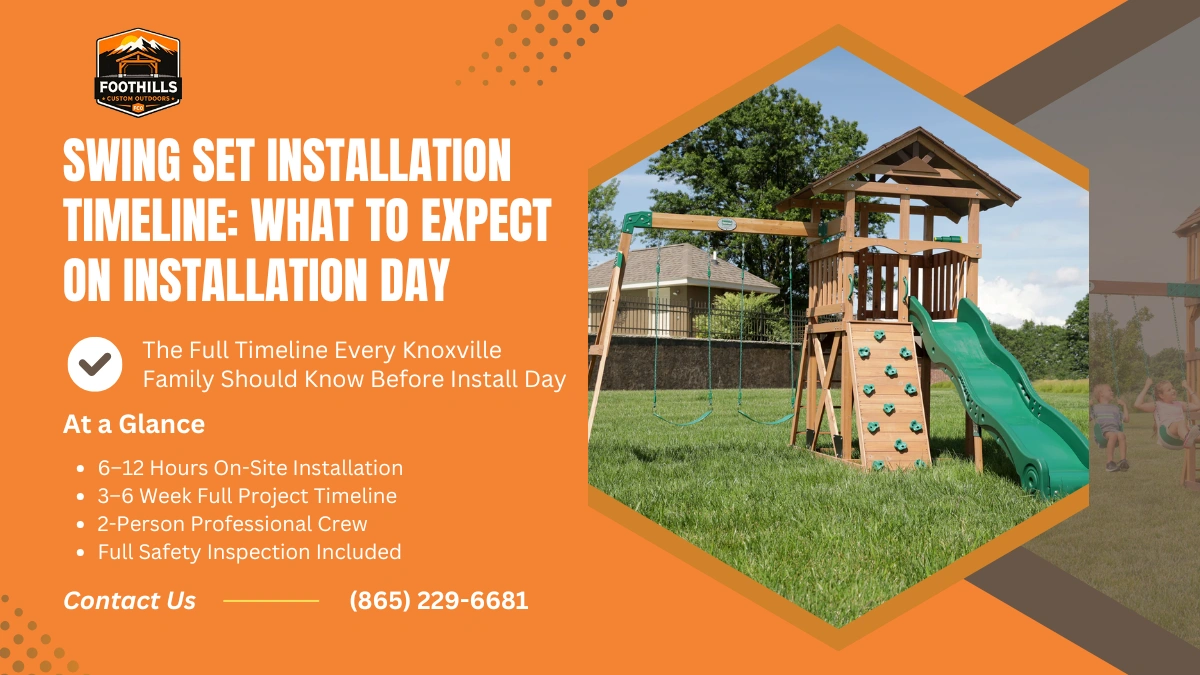
Swing Set Installation Timeline: What to Expect on Installation Day
You have ordered the swing set. The delivery is confirmed. The installer is booked. Now the question every Knoxville parent asks in the days leading up to the appointment: how long will this actually take, and what am I supposed to do while it happens?
This guide walks through the complete swing set installation timeline in real time. From the two-week mark before install day, through the hour-by-hour breakdown of the day itself, through the first week after handoff when the kids are climbing on it and you are checking hardware. Every phase, every checkpoint, every moment where the timeline can slip and how it usually recovers. Localized to East Tennessee conditions, because Knoxville summers, foothill terrain, and thunderstorm patterns actually shape how installation days go here.
By the end of it, you will know exactly what to expect the morning the crew pulls into your driveway, exactly when the swings will be safe to use, and exactly how the whole project fits into your family calendar. No surprises.
How Long Does Swing Set Installation Take? The Quick Answer
The direct answer, then the honest one.
Direct answer: For a professional installation of a mid-size wooden swing set in the Knoxville area, plan on 6 to 12 hours of on-site work, typically completed in one day. Compact starter sets can finish in 4 to 6 hours. Large multi-tower playsets with monkey bars, extensive climbing accessories, and covered decks routinely run 10 to 16 hours, sometimes across two days.
Honest answer: The on-site assembly is only part of the timeline. From the day you place your order to the day your kids are safely swinging, the full project timeline runs 3 to 6 weeks in the Knoxville area, depending on manufacturer lead time, delivery scheduling, installation booking, weather, and any site prep work required. Understanding the whole timeline matters more than fixating on the install day itself.
Here is what that full 3 to 6 week window actually looks like.
The Full Project Timeline: From Order to First Swing
| Phase | Typical Duration in Knoxville | What Happens |
|---|---|---|
| Order and manufacturer prep | 1 to 2 weeks | Playset built or pulled from stock, prepared for freight |
| Freight delivery scheduling | 3 to 7 days | Freight company contacts you, sets a delivery window |
| Freight delivery to home | 1 day | Boxes and hardware dropped in your driveway or garage |
| Installation scheduling window | 3 to 14 days | Installation team schedules based on their availability and your yard’s readiness |
| Site preparation (if separate) | 1 to 3 days | Grading, drainage, foundation work if included in scope |
| Installation day | 1 day (occasionally 2) | The full assembly, anchoring, safety inspection, and handoff |
| First-use safety period | 24 to 48 hours after install | Hardware settling check, first-day usage window |
| Break-in period | 1 to 2 weeks | Hardware retorquing after initial settling, first heavy-use assessment |
Spring and early summer are peak installation season in the Knoxville market. April through July, installation lead times can stretch to the longer end of the range as families rush to get playsets ready for summer break. Booking in early spring gets you ahead of the crowd. Booking in late fall or winter often gets you the shortest lead times of the year, though weather can push installation day itself.
Two Weeks Before Installation Day: Setting the Foundation
The clock effectively starts when your order is confirmed. Two weeks out from your scheduled installation, the following activities should be in motion.
Manufacturer lead time is running: For most Backyard Discovery playsets stocked at Foothills, the product is either ready to ship or in preparation. If your model is on backorder, this is when you would already know it.
Delivery coordination is beginning: Foothills handles delivery and placement coordination so you are not managing the freight logistics on your own. The freight company will contact you 3 to 7 days before delivery to set a window.
Your yard should be under evaluation: If your yard needs meaningful preparation (leveling, drainage, tree work, retaining wall adjustments), two weeks is your window to get it started. Many homeowners underestimate how much prep their yard actually needs. A site walkthrough at this stage prevents surprises on install day.
Utility marking should be scheduled: In Tennessee, you must call 811 (or submit online) at least three business days before any ground disturbance. Two weeks is early enough to submit the request and be certain the marks will be fresh on install day. Tennessee 811 markings are valid for 15 business days, so the window works cleanly.
Consider your access path: If the delivery truck cannot get close to the install site, someone has to carry every box across your yard. Boxes for a mid-size playset can weigh 400 to 800 pounds distributed across 4 to 8 packages. Confirm a clear path at least 4 feet wide from where the freight truck will unload to the install location.
One Week Before Installation Day
Seven days out, the pace picks up.
Confirm your installation appointment: Foothills’ installation coordinator will typically reach out to confirm the date, arrival window, and any last-minute scope questions. Anything about the installation you have not clarified, clarify now.
Mow the install area short: Cut the grass in the entire play zone plus the safety buffer around it. Short grass makes leveling faster, helps the crew see the ground clearly, and makes anchoring easier.
Clear the safety zone: The finished playset needs at least 6 feet of clearance in all directions from the structure, and up to 12 feet in front of and behind the swing beam depending on swing length. Move all lawn furniture, planters, garden decor, kids’ toys, and anything else out of the entire clearance envelope now.
Trim overhead branches: Any branch within 8 feet vertically above the finished playset needs to be trimmed back. Knoxville homeowners under mature oak, maple, and pine canopy often forget this step. A branch that will hang directly above a rope net or climbing wall is a safety issue.
Confirm your access path is unobstructed: Fence gates open. Cars moved out of the way. Any tools, garden equipment, or seasonal items relocated from the path between the driveway and the yard.
Weather watch begins: Start monitoring the extended forecast. Knoxville spring and summer weather is famously changeable. A cold front or a chance of thunderstorms 24 to 48 hours out may trigger a reschedule conversation with your installer.
The Day Before Installation
Final prep, in checklist form.
- Confirm the crew arrival time in writing (text or email)
- Confirm which adult 18 or older will be present the entire day
- Move all vehicles out of the driveway and off the access path
- Ensure a working outdoor electrical outlet is accessible for the crew’s power tools if needed
- Have water and shade available for the crew (they will be outside for the full day)
- Plan pet care so pets are indoors or otherwise safely away from the work area for the full duration
- Plan childcare so children are not on-site during the build (safety, and it lets the crew work faster)
- Recheck utility markings if the 811 marks have faded (in Tennessee summer sun, spray paint can fade quickly)
- Verify the ground in the install area is level within manufacturer tolerance (about 1 inch of variation across the footprint is typically acceptable)
- Have the freight boxes accessible in the location you designated, unopened
That last point is important. The crew inventories every part from the packaging when they arrive. Boxes opened ahead of time can cause missed items, warranty claim complications, and a slower start to the day.
Installation Day: The Complete Hour-by-Hour Timeline
Here is the honest, timed walk-through of what a Knoxville-area professional installation looks like for a mid-size wooden swing set. Times are typical; complex builds shift the whole schedule later.
7:00 to 7:30 AM: Crew Arrival and Site Walkthrough
The truck pulls in. The crew arrives ready to work. The lead installer greets you, walks the site, confirms the exact placement and orientation of the finished playset, and answers any last-minute questions. Photographs of the site condition are taken for documentation.
You should be present for this walkthrough. Once the crew starts building, changing the location is expensive and time-consuming. This is your last easy chance to say “actually, let’s shift it three feet north.”
What happens if placement is different from expected?
The crew will pause and confirm. Any changes to the pre-agreed scope are documented and, if they affect cost or timeline, communicated to you before work resumes.
7:30 to 8:00 AM: Tool and Material Staging
The crew unloads their tools: torque wrenches (not just cordless drills, a distinguishing mark of a professional crew), levels, laser or spirit levels, ladders, safety equipment, hardware bags, and any specialized components. A staging area is set up on tarps or drop cloths to keep parts organized and off wet grass.
If the freight boxes are not already at the install site, the crew moves them from the delivery point (driveway, garage) to the staging area. This can take 20 to 45 minutes depending on the number of boxes and the distance.
8:00 to 9:30 AM: Inventory Check and Hardware Verification
Every box is opened. Every component is checked against the manufacturer’s parts list line by line. Every bag of hardware is sorted and verified. This phase takes 60 to 90 minutes on a mid-size playset and is the single most valuable use of the crew’s early hours.
Why the emphasis? Because a missing part discovered at hour 8 stops the entire assembly. A missing part discovered at hour 1 gives the crew and the dealer time to source it and reschedule the completion if necessary, without wasting a full day of crew time. Foothills, as an authorized Backyard Discovery dealer, has direct access to Backyard Discovery’s parts network, which speeds up the resolution significantly when it is needed.
What happens if something is missing? The crew documents the shortage, contacts the dealer or manufacturer immediately, and either finds a workaround that maintains the manufacturer’s specification or pauses that section until the replacement arrives.
9:30 to 10:30 AM: Foundation Prep and Anchor Marking
Ground level is verified with a laser level or spirit level across the entire playset footprint. Any low spots that need minor adjustment are addressed. Anchor locations are marked based on the manufacturer’s specification. If concrete footers are part of the scope, they are placed and set to cure during the assembly hours (concrete typically needs 24 to 48 hours to reach the strength required for full load, though the frame can be assembled on top of it once the concrete has set).
On Tier 3 full-service installations with meaningful site preparation and foundation work, this phase extends significantly. On level, prepared yards, it wraps in an hour.
10:30 AM to 1:00 PM: Main Frame Assembly
The heart of the build. Base frame, corner posts, deck framing, roof or canopy support structure, swing beam. Each stage is squared, leveled, and torqued to specification before the next stage adds load.
Squaring is a critical checkpoint: A properly squared frame is measured by diagonal, not by corner. A crew that only spot-checks the corners can miss a build that is out of true by half an inch across the diagonal, which causes swing motion problems, uneven deck loading, and long-term stress on the frame. A professional crew always measures diagonally and adjusts as needed.
The swing beam is set with particular care: Level, height, and the securement to the frame determine whether the swings themselves function correctly for the next 15 to 20 years. Any wobble at this stage is corrected before the swings are hung.
Mid-morning coffee break for the crew usually falls somewhere in this window. Assume 15 to 20 minutes.
1:00 to 1:30 PM: Midday Break and Progress Check
Lunch break for the crew, and a natural progress check for you. Walk out, look at what has been built, ask questions. The lead installer will typically volunteer a mid-day update: what phase is complete, what is next, whether the timeline is holding.
This is also when weather concerns are usually raised if the afternoon forecast has shifted. A Knoxville summer afternoon that showed clear skies at 7 AM can turn into a 3 PM thunderstorm warning by lunchtime.
1:30 to 4:00 PM: Deck, Roof, Slide, Swings
Deck platform boards are installed and secured. Roof panels or canopy sections are placed. Slides, climbing walls, monkey bars, and swings are attached. Every accessory is torqued and tested.
This is often the visually satisfying part of the build. The frame has looked like a skeleton for hours; now the recognizable playset shape emerges.
Slide installation is a critical safety phase: The slide angle and the exit-height clearance must match the manufacturer’s specification. A slide installed with the wrong bracket set or the wrong angle creates a safety issue that only shows up when children start using it.
4:00 to 5:00 PM: Anchoring
The playset is now structurally complete. Anchoring locks it to the ground. Manufacturer-supplied ground anchors are installed at each corner post. For sites requiring concrete footers or engineered anchoring, this phase started earlier and finishes now with final structural ties. Every professional installation gets proper anchoring and wind protection engineering matched to the specific site conditions.
After anchoring, the whole structure is stress-tested. The crew pushes, pulls, sways, and applies force to confirm nothing rocks, shifts, or moves under load. Any give at this stage means the anchoring is adjusted before the safety inspection begins.
5:00 to 6:00 PM: Safety Inspection and Handoff
The final phase, and the reason you paid for a professional crew. Every fastener re-checked for torque. Every joint inspected for tightness. All sharp edges, protrusions, and pinch points examined against ASTM F1148 residential playground equipment safety standards. Entrapment gaps measured (openings between 3.5 and 9 inches are prohibited because they can trap a child’s head). Fall zones measured. Swing spacing verified. Warning stickers and identification decals placed.
Then the homeowner walkthrough. The lead installer walks you around the finished playset, points out anchoring locations, explains the maintenance schedule (retorque hardware at 30 days, then annually; seal or stain wood every 2 to 4 years), and confirms warranty coverage and next steps.
Photos are taken for documentation. Packaging debris is piled in the location you designated. The crew loads out, and the swing set is officially yours.
Total on-site time for the mid-size playset walked through above: roughly 10 to 11 hours. Larger playsets extend into the swing set assembly services that run up to 16 hours, sometimes across a second day. Smaller sets wrap in 5 to 7 hours.
Crew Size: How It Changes the Timeline
Crew size is the single biggest variable in installation duration after playset complexity. Here is how the math actually works.
Solo installer: Realistic only for the smallest metal or compact wooden sets. Even then, the timeline stretches significantly because one person cannot hold heavy components in place while fastening them. Not the standard approach for reputable services.
Two-person crew: The standard configuration for most residential swing set installations in Knoxville. One person holds and positions, one person fastens. A mid-size wooden playset that a two-person crew completes in 10 to 11 hours would take a solo installer 15 to 18 hours.
Three-person crew: Deployed for larger playsets, complex builds, and when a homeowner has requested a same-day completion for a build that would otherwise stretch to a second day. A three-person crew on a mid-size playset can compress the timeline to 6 to 8 hours, but the labor cost typically increases proportionally.
Four-person or larger crew: Reserved for the largest playsets, commercial-adjacent builds, and full-service installations with concurrent site prep. Uncommon in residential settings.
Foothills matches crew size to the specific playset and site conditions. A tight two-person job does not need three installers standing around; a large multi-tower job does not benefit from being handled by two people over two days when three could finish it in one.
Weather Delays: When Knoxville Weather Interrupts
East Tennessee weather affects installation day timing in specific and predictable ways. Understanding the patterns helps you plan.
Temperature minimums: Installation requires temperatures of at least 40 degrees Fahrenheit for reliable results. Below that, adhesives, hardware, and hands do not perform well. Knoxville winters have enough mild days that installations can be scheduled between December and February, but expect potential reschedules for cold snaps.
Rain: Light drizzle is workable; steady rain stops installation. Wet wood is harder to work, hardware slips, and safety on ladders and staging drops significantly. Most crews will pause work and either wait out a passing shower or reschedule for a full-day rain.
Thunderstorm risk: The most common Knoxville summer reschedule trigger. Afternoon thunderstorms roll in with limited warning between May and September. A crew watching a mid-afternoon storm cell developing may wrap up a phase and pause, or if the timing is right, complete the build and load out before the storm hits.
Muddy or saturated ground: Even after the rain stops, ground that is saturated makes anchoring problematic and can compromise the foundation. A crew arriving to a muddy site after a heavy overnight rain may reschedule rather than push through.
High winds: Sustained winds above about 25 miles per hour make handling large wood panels and roof sections dangerous. Rare in Knoxville but a real reschedule trigger during severe weather events.
Reschedule policy: A good service builds flexibility into weather-driven reschedules and communicates them early. Foothills’ scheduling coordinator will typically reach out the morning of an at-risk installation to confirm or reschedule based on the current forecast.
Peak reschedule season: Late March through May (thunderstorm season starts), and December through February (cold and rain). Booking installations in June, August, September, October, or early November tends to see the fewest weather disruptions in this climate.
What “Ready to Use” Actually Means
The crew leaves. The playset stands in your yard. Your kids are asking when they can climb on it. Here is the honest answer to “ready to use” in each dimension.
Immediately usable: As soon as the crew departs and the safety walkthrough is complete, the playset is structurally sound and safe for supervised use. Swings, slides, and climbing features are all functional.
Cure period for concrete footers: If concrete footers were part of your installation, the manufacturer’s cure specification governs. Standard concrete reaches sufficient strength for playset loads in 24 to 48 hours, though full 28-day cure strength is what engineered plans specify. The playset frame is anchored to the wet or partially cured concrete during assembly; the concrete continues curing under the frame after installation. Heavy sustained use in the first 48 hours is fine on standard installations; extreme loading (four adults simultaneously on the swing beam, for example) should wait for full cure.
Break-in period: Wood swing sets settle in their first weeks. Hardware that was torqued to specification on install day can loosen slightly as the wood adjusts to load, moisture, and temperature swings. A good service either includes a 30-day follow-up visit to retorque or provides the tools and instructions for the homeowner to do it. Retorquing is not optional; it is the difference between a playset that stays tight for years and one that develops rattles and wear.
Safety surfacing: If safety surfacing (engineered wood fiber, rubber mulch, poured rubber) is being added, it goes down after the playset is anchored. Loose-fill surfacing is usable immediately; poured surfacing needs its own cure time (typically 24 to 72 hours) before children can use the play area.
Stain or sealer: Freshly assembled wooden playsets sometimes benefit from an initial sealing pass, though many manufacturers recommend waiting 30 to 90 days after installation for the wood to acclimate before applying stain. Check the manufacturer’s specification.
The First Week After Installation
The playset is up. Here is what your first week looks like.
Day 1: Kids climb. You watch closely for anything unexpected. Photograph any concerns.
Day 2 to 3: Continued use. Listen for any developing squeaks or rattles (early signs of hardware settling).
Day 4 to 5: Check bolt heads visually. Anything that looks slightly proud of the wood or off-angle may need attention.
Day 7: First serious inspection. Walk around the entire playset and gently test every railing, every hand grip, every swing chain attachment. Push and pull on posts to confirm nothing has developed movement. If you notice any give, contact the installer for a follow-up.
Days 8 to 14: Continued monitoring. Most break-in settling that will happen has happened by day 14.
Day 30: The full workmanship warranty check-in. Many services offer a courtesy retorque visit at this point. Take them up on it.
Swing Set Assembly Services That Run Up to 16 Hours
Not all playsets are small. The largest wooden playsets in the Foothills swing sets and playsets lineup can push assembly to 14 to 16 hours, and sometimes require a second day.
What makes a build a 16-hour assembly?
- Multiple towers or tiered platforms (each additional tower adds 2 to 3 hours)
- Full-length monkey bars requiring precise alignment across the play space
- Rock walls or climbing walls with specialized hardware and mounting
- Covered decks with roof panel systems
- Multiple slide types (straight, spiral, tube)
- Extended swing beams with 3 or 4 swing positions
- Attached playhouse or clubhouse structures
- Custom accessories or upgrade packages
For these builds, a two-day schedule is often the practical choice. Day one: delivery coordination, site prep verification, inventory, foundation, and main frame assembly. Day two: decks, roof, accessories, anchoring, safety inspection, handoff.
A two-day install is not a sign of poor scheduling. It is often the honest answer to how much work a large playset actually requires. Trying to compress a 16-hour build into a single 14-hour day with crew fatigue and dwindling daylight creates more risk than it saves in time.
Timeline by Playset Complexity Level
For quick reference, here is how the on-site timeline scales across common playset categories:
| Category | Typical Assembly Time | Typical Crew Size |
|---|---|---|
| Compact metal A-frame swing set | 3 to 5 hours | 2 |
| Compact wooden swing set (basic swings and slide) | 4 to 6 hours | 2 |
| Mid-size wooden playset with deck and slide | 6 to 10 hours | 2 |
| Large wooden playset with tower and multiple accessories | 10 to 14 hours | 2 to 3 |
| Premium multi-tower playset with monkey bars, rock wall, covered deck | 14 to 16+ hours (often 2 days) | 2 to 3 |
| Custom installation with meaningful site prep | Add 4 to 12 hours for site prep | 2 to 3 |
These are professional installer times. DIY builds of the same playsets routinely take 2 to 3 times as long. The DIY tradeoff, for anyone considering it, is covered in the companion piece on the risks of DIY swing set assembly in the Knoxville area.
What Can Extend Your Timeline
The most common causes of longer-than-expected installations:
- Missing or damaged parts requiring a manufacturer replacement (adds days to weeks depending on availability)
- Site prep discovered as needed after the crew arrives (sloped or wet ground that was not disclosed)
- Underground obstructions encountered during anchoring (rocks, roots, utility lines not marked)
- Weather interruptions midway through the build
- Homeowner scope changes made on-site (adding accessories, changing orientation)
- HOA or permit issues raised after installation begins
- Access problems discovered after arrival (locked gate, blocked path)
- Adult authorization not present when needed
- Freight delays pushing the delivery date later than planned
Most of these are avoidable with proper pre-install communication.
What Can Shorten Your Timeline
The most common causes of faster-than-expected installations:
- Level, well-prepared ground with no site prep needed
- All boxes already staged at the install location before the crew arrives
- Utility marks fresh and clearly visible
- Clear access path with no obstructions
- Homeowner reachable but not on-site for the working hours (crews work faster without hovering)
- Optimal weather (dry, temperate, low wind)
- Well-organized inventory matching the manufacturer’s specification
- Three-person crew for a build that would take a two-person crew a full day
- No last-minute scope changes
A well-prepared homeowner can shave 1 to 2 hours off a typical installation just by having everything ready before the crew pulls in.
Frequently Asked Questions
How long is the entire process from ordering to a fully usable playset in Knoxville?
Plan for 3 to 6 weeks from order to first swing. Manufacturer prep and freight delivery typically account for 2 to 3 weeks; installation scheduling accounts for another 1 to 2 weeks in peak season; installation day itself is 1 day (sometimes 2 for large builds); and break-in observation runs another 1 to 2 weeks. Peak spring and summer demand can push the total to the longer end of the range.
Can the installation be completed in a single day?
For compact and mid-size playsets, yes, with a two-person crew arriving early. For large and premium multi-tower playsets that require 14 to 16 hours of work, a two-day schedule is often the safer choice than trying to compress the build into one very long day. Confirm the expected duration with your installer at booking.
What is the earliest my kids can safely use the swing set?
As soon as the crew completes the safety walkthrough and hands off the finished playset. Structural integrity is confirmed before the crew leaves. If concrete footers were part of your installation, extreme loading (multiple adults on the swing beam) should wait 24 to 48 hours for the concrete to reach working strength; normal kid-scale use is fine immediately.
What happens if the weather turns bad during installation?
Light rain and mild wind are usually workable. Heavy rain, thunderstorms, or high winds will pause the work. The crew will either wait out a passing shower or reschedule if the delay would push the finish into darkness or unsafe conditions. Your installer should communicate any weather-driven changes promptly.
Do I need to be home the entire day?
An adult 18 or older with authority to make placement decisions must be present for the full duration. That does not necessarily mean the same person needs to stand outside for 10 hours; it means someone with authority needs to be reachable, on-site, and available for the arrival walkthrough, any mid-day decisions, and the final handoff.
Can the crew work through lunch to finish earlier?
Most crews take a short lunch break for both nutrition and pace. Working straight through a 10-hour physical build without a break degrades quality by late afternoon. A 30 to 45 minute midday break is the norm and does not meaningfully extend the finish time.
What happens if you find a part is missing after starting?
The crew documents the missing part, contacts the dealer or manufacturer immediately, and either finds a workaround that maintains the manufacturer’s specification or pauses that section until a replacement can be sourced. As an authorized Backyard Discovery dealer, Foothills has direct access to Backyard Discovery’s parts network, which typically means faster resolution than a third-party installer would achieve.
How many people are typically on the installation crew?
Two-person crews are the standard for most residential swing set installations in the Knoxville area. Three-person crews are deployed for larger playsets, complex builds, and same-day completion of what would otherwise be a two-day build. Solo installations are rare and generally reserved for the smallest metal A-frame sets.
What if my yard is not fully prepared when the crew arrives?
If the ground is meaningfully unlevel, drainage is poor, or obstructions are present that were not disclosed, the crew has the right to refuse installation, reschedule, or upgrade the scope to include the necessary site preparation at additional cost. This is why the pre-install site walkthrough matters so much: it catches these issues before install day.
Is installation day noisy?
Yes, moderately. Cordless drills, torque wrenches, occasional hammering, and crew conversation are all part of the workday. Neighbors within about 100 feet will notice the activity. If you are in a subdivision with sensitive HOA rules about noise or working hours, confirm those restrictions with the installer at booking.
Can I watch the installation happen?
You are welcome to watch, and many parents enjoy seeing the build take shape. What is not recommended is having children playing in or around the work area, both for safety and because the crew works faster without needing to actively watch for kids around ladders, tools, and heavy components.
How much does the installation cost separately from the playset?
Installation pricing depends on playset size, site conditions, and service tier. Detailed pricing for the full range of Backyard Discovery playsets in the Foothills lineup is available on the swing set assembly cost breakdown for the Knoxville area. Foothills carries a $1,000 minimum labor floor on installation service to cover crew, tools, permitting coordination, and site work even on the smallest builds.
What to Do the Morning of Installation
Final pre-arrival routine, if it helps to have it in one place:
- Wake up 30 minutes earlier than you think you need to
- Coffee ready for the crew if you are inclined (they will appreciate it, though it is not expected)
- Vehicles moved off the driveway and access path
- Fence gates opened and secured back
- Pets inside or in a separate enclosed area
- Kids briefed to stay clear (or arrangements made for them to be elsewhere)
- Phone charged and reachable through the day
- Any last-minute questions written down so you can ask them during the morning walkthrough
Then meet the crew at arrival, walk the site together, and let the day unfold. The next 6 to 12 hours are the crew’s job; you can go about your morning after the walkthrough.
After Installation: Enjoying the Investment
A well-installed swing set in the Knoxville area lasts 15 to 20 years with basic maintenance. That translates to roughly 5,000 to 7,000 days of usable play time. The 8 to 12 hours you spend on installation day, and the 3 to 6 weeks you spend on the full project timeline, produce a permanent addition to your backyard that your children and their friends will use through elementary school and beyond.
Understanding the timeline upfront is what turns installation day from a source of uncertainty into an event you can plan around. You know what to expect at 7:30 AM. You know what to expect at 1 PM. You know when your kids can start climbing. You know what to check at day 30. The whole process, from the first order confirmation to the retorque check a month in, is a defined sequence with predictable checkpoints.
Foothills Custom Outdoors serves Knoxville, Farragut, Hardin Valley, Bearden, Maryville, Alcoa, Sevierville, Oak Ridge, and the broader East Tennessee area as a full-service outdoor structure builder combining product selection with skilled installation under one team from design through the final walk-through. The timeline in this guide is the honest picture of what our installations actually look like. If you are planning a swing set purchase and want to talk through the schedule for your specific yard, the direct route is the contact form for a project conversation.
The kids get their swing set. You get your Saturday afternoons back. That is the whole point.