How to Choose the Right Pergola Installer in Knoxville: Questions to Ask
The pergola you end up with in five years is not really a product decision. It is a contractor decision. The same aluminum louvered pergola installed by two different Knoxville-area crews can look identical on delivery day and diverge dramatically by year three: one still perfectly square, anchored, and standing tall through summer thunderstorms; the other visibly leaning after the first hard freeze-thaw cycle, with fasteners working loose and warranty claims stuck in dispute because the install did not follow specification.
The good ones are worth every dollar. The bad ones cost you the price of the install plus the price of eventually redoing it. And the difference is not always obvious from a quote alone or a friendly first phone call.
This guide gives you the vetting framework to tell them apart before you sign anything. Fifteen essential questions to ask every pergola contractor. A verification checklist for licensing and insurance in Tennessee. What a proper pergola installation quote should include (and what missing line items reveal). Twelve red flags that should end the conversation. Reference-check questions that actually surface useful information. And a 20-item pre-contract checklist to work through before you commit.
Bring this to your first three contractor meetings. Use it as a working document. The extra hour of homework up front is what protects the $8,000 to $30,000 investment that follows.
Before You Start Interviewing: Know What Kind of Installer You Are Actually Comparing
“Pergola contractor” is a loose term that covers several genuinely different business models. Comparing quotes across categories without understanding what you are actually comparing leads to bad decisions. Here is how the market sorts out.
The general handyman or handyperson service
Assembles pergola kits alongside furniture, sheds, and other flat-pack construction. Typically the cheapest quotes. Trade-off: usually no meaningful specialty in pergola engineering, foundation work, permitting, or anchoring for wind loads. Fine for the smallest aluminum kits on level ground; not the right choice for permanent, professionally engineered installations.
The landscape company with pergola capability
Landscape design and installation firms that offer pergolas as one line item among lawns, hardscape, drainage, and general yard work. Trade-off: quality varies widely. Some are excellent (real construction crews on staff, real engineering knowledge). Some subcontract the actual pergola work to a third party. Ask specifically who is doing the pergola build.
The authorized dealer or manufacturer installer
Contractors specifically trained and certified on a particular pergola brand or product line. Trade-off: strongest warranty support and specification adherence for that brand; may be limited to only the brands they represent. Foothills operates in this category as an authorized Backyard Discovery dealer for pergolas, gazebos, and related outdoor structures.
The specialized pergola contractor
Firms that focus meaningfully on pergolas, patio covers, and outdoor shade structures. Trade-off: usually the deepest specialty knowledge; sometimes more expensive; sometimes has waiting lists in peak season.
The custom builder or general contractor
Full construction firms that build pergolas as part of larger outdoor living or home improvement projects. Trade-off: strongest for premium custom masonry-piered pergolas and integrated outdoor room builds; typically the most expensive; not the right choice for standalone modest pergola installs.
Which category you should be talking to depends on the pergola you actually want. A 10×10 aluminum kit does not need a specialty pergola contractor; a $22,000 louvered aluminum motorized system does. A cedar pergola tied into a broader outdoor kitchen and patio build often benefits from a full-service builder who can coordinate the whole project rather than three separate trades.
Once you know which category fits your project, the vetting questions below apply within that category.
The Verification Checklist: What to Confirm Before You Sign
Before you even get into design and pricing conversations, verify these six items about any pergola contractor you are seriously considering. All six should be answerable in writing within 24 to 48 hours.
1. Business registration: The contractor should operate under a registered business name in Tennessee. Look them up on the Tennessee Secretary of State business filing search. A contractor with no registered business entity is a red flag regardless of what their marketing materials look like.
2. Contractor’s license (if applicable): In Tennessee, projects over $25,000 typically require the contractor to hold a state contractor’s license (the exact threshold and rules depend on project type and current state law; verify the current threshold with the Tennessee Department of Commerce and Insurance Contractors Licensing Board before booking a larger project). Smaller pergola projects may fall below the threshold requiring a full license, but the contractor should be transparent about their credentials regardless.
3. Local business permits: A Knox County or City of Knoxville business license, plus any relevant county-level registrations. Verify the contractor is legally permitted to do business in your specific location.
4. General liability insurance: Minimum $1,000,000 general liability coverage is the standard for outdoor construction contractors in this market. The contractor should provide a certificate of insurance (COI) on request, and you can call the insurance carrier directly to verify the policy is current.
5. Workers’ compensation coverage: If the contractor has employees, they must carry Tennessee workers’ compensation insurance. This protects you from liability if a worker is injured on your property. If the contractor operates as a sole proprietor with no employees, this may not apply; ask directly.
6. References from recent local projects: At least three references from projects completed in the past 12 months in the greater Knoxville area. If they cannot produce three recent local references, this is a red flag.
Any legitimate pergola contractor produces all six of these items without hesitation. Any contractor who resists, delays, or offers excuses for missing items has already given you the answer you need.
The 15 Essential Questions to Ask Every Pergola Contractor
Use this as a working interview script for each contractor you meet. Ask the same questions to each, take notes, and compare answers.
Company and Experience Questions
Question 1: How long have you been installing pergolas in the Knoxville area, and how many pergolas have you built in the last year?
You are looking for experience that is both meaningful (multi-year track record) and current (active recent work). A contractor who built 40 pergolas last year has the operational rhythm to handle yours efficiently. A contractor who built two in the last two years may be perfectly capable but is not doing the volume that develops deep specialization.
Question 2: Are you licensed and insured, and can you provide documentation?
Basic verification question. The right answer is “yes, and here it is” delivered within 24 hours in writing. Any other answer is a warning.
Question 3: Do you build pergolas yourself, or do you subcontract the work to another crew?
Some contractors are actually general contractors who subcontract the physical build to a third-party crew. This is not automatically bad, but you deserve to know who is doing the actual work, who bears responsibility if something goes wrong, and who carries the workmanship warranty.
Question 4: Can you provide references from at least three recent local pergola projects, ideally within the past 12 months?
Recent local references are the most useful because they reflect current crew, current pricing, and current work quality in a climate similar to yours.
Product and Specification Questions
Question 5: What pergola brands, materials, and systems do you install, and which one do you recommend for my specific yard?
A good contractor has genuine opinions and can explain the trade-offs. A contractor who says “any of them are fine” without evaluating your specific site is not thinking carefully about your project.
Question 6: What material grade or specification are you proposing, and why?
For aluminum pergolas, aluminum grade (6063-T5 vs T6, for instance) affects strength and durability. For wood pergolas, the species, grade, and treatment specification matters. For louvered systems, the motor specification, drainage design, and wind rating matter. A contractor who can speak to these specifications knows their product; a contractor who cannot is selling on marketing rather than engineering.
Question 7: What is the wind rating of the pergola you are proposing, and how does that compare to Knoxville’s actual wind profile?
Knoxville sees straight-line thunderstorm gusts of 55 to 70 miles per hour several times a year, with severe events reaching 70 to 90 miles per hour every 3 to 5 years. The pergola’s rated wind capacity, combined with proper anchoring, should carry meaningful margin above the actual conditions the yard sees. A contractor who cannot cite specific wind ratings is not paying attention to a real safety consideration in this region.
Question 8: What warranty comes with the pergola product itself, and how do warranty claims work?
Product warranties from manufacturers vary widely (typically 5 to 25 years on structural components, less on motors and finish). The contractor should be able to explain the specific warranty terms on the product they are proposing, how claims are made, and what documentation is required.
Site and Installation Questions
Question 9: Have you walked the specific install site, and what site preparation does my yard need?
A quote produced without a site walk is not a real quote. The contractor should have visited your yard, measured the space, evaluated the ground conditions, identified any obstacles, and confirmed the placement.
Question 10: What foundation approach are you specifying for my site, and why?
The right foundation depends on soil, site conditions, pergola size, and expected wind loads. For most Knoxville-area pergolas, concrete footers dropped below the frost line (typically 12 inches) at each corner post are the standard. Ground anchors alone are not adequate for permanent installations in the Tennessee wind profile. The contractor should be able to explain their foundation approach in specific terms.
Question 11: How will you anchor the pergola against Tennessee wind loads?
The safety-critical question. The contractor should be able to describe the specific anchoring approach for your site, whether standard footers are sufficient or upgraded engineered anchoring is warranted, and how the anchoring choice matches the pergola’s wind rating. The anchoring and wind protection engineering service approach that Foothills takes on this specific question is a good reference for what a thoughtful answer looks like.
Warranty and Service Questions
Question 12: What workmanship warranty do you offer on the installation itself?
Separate from the manufacturer product warranty. A reputable Knoxville-area installer covers their own installation for at least one year, often longer. This warranty covers installation errors: settling, wobble, hardware issues traceable to the install rather than the product. A contractor who offers no workmanship warranty is telling you they will not stand behind their own work.
Question 13: If there is an issue after installation, what is the response process and timeline?
The answer should be specific: how to report an issue, expected response window, whether service visits are scheduled during business hours or accommodate homeowner schedules, and what happens if the issue is disputed. Vague answers signal a company that does not actually handle post-install service well.
Question 14: Do you handle permits and inspections, or do I need to?
The right answer for most projects is that the contractor handles permits and inspections as part of the base scope. Some contractors leave this to the homeowner, which is a red flag unless clearly disclosed and priced accordingly.
Quote and Payment Questions
Question 15: What is your payment schedule, and what percentage do you require as a deposit?
Standard payment structure in the Knoxville pergola market: 25 to 40 percent deposit at contract signing, progress payments at defined milestones (materials delivered, foundation complete, structure complete), and final payment at homeowner walkthrough and acceptance. Contractors demanding full payment upfront, or deposits above 50 percent, are outside industry norms. Contractors who ask for cash-only payment are a significant red flag.
How to Verify a Pergola Contractor Is Reliable
Beyond the six-item verification checklist above, five deeper verification steps separate reliable pergola contractors from unreliable ones.
Verify the business registration independently
Search the Tennessee Secretary of State business filing database (available online) for the contractor’s business name. Confirm the entity is active, current on filings, and organized under a legal business structure. A pergola contractor operating without a registered business is not just unusual; it is a legal issue for you if things go wrong.
Verify insurance by calling the insurance carrier
The certificate of insurance the contractor provides shows the policy number and carrier. Call the carrier directly (using a number you look up independently, not one the contractor provides) and confirm the policy is current, at the coverage limits stated, and that the contractor is listed as the named insured.
Check the Better Business Bureau and online review sites
Look at BBB accreditation status, resolved and unresolved complaints, and reviews on Google, Yelp, and Angie’s List. Pay attention to how the contractor responds to negative reviews. A contractor who responds professionally and works to resolve issues is telling you how they will handle problems on your project.
Check licensing status through the Tennessee Contractors Licensing Board (if applicable for the project size)
For projects requiring a state contractor’s license, verify the license is current and in good standing through the official Tennessee Department of Commerce and Insurance database. Note any disciplinary history.
Ask about complaints, claims, and legal issues directly
Any established contractor will have handled some customer complaints; that is normal. What matters is how they were resolved. A contractor who has been sued by clients, has open BBB complaints, or has a pattern of unresolved warranty claims is showing you a pattern.
What Should Be Included in Every Pergola Installation Quote
A proper pergola installation quote itemizes every line of the project so you can see exactly what you are paying for. Here is the complete checklist of what a professional quote should cover.
Product specification:
- Pergola make, model, and complete specification
- Size and dimensions (exact footprint)
- Material grade and finish (aluminum series, wood species and treatment, powder coat color)
- Roof or slat system details (fixed, louvered, motorized)
- Any included accessories (drainage, integrated LEDs, motors, sensors)
Installation labor:
- Delivery and staging labor
- Site preparation scope and estimated labor hours
- Foundation work (type, size, and cost of each element)
- Structural assembly labor
- Anchoring hardware and approach
- Finish work (rafter cuts, hardware covers, cleanup)
- Debris removal (on-property placement vs off-property haul-away)
Coordination and administration:
- Permit fees and coordination
- Inspection scheduling
- HOA architectural review coordination if applicable
Warranty terms:
- Product warranty terms (length, coverage, claim process)
- Workmanship warranty terms (length, coverage, response process)
- Both documented in writing separately
Payment structure:
- Total price with tax
- Deposit amount and timing
- Progress payment milestones and amounts
- Final payment terms
- Cancellation policy
Timeline:
- Estimated start date range
- Estimated on-site work duration
- Total project timeline from contract to completion
- Weather contingency policy
Add-ons and optional items:
- Any items priced separately (lighting, fans, upgrades)
- Clear disclosure of what is and is not included in the base price
- Optional upgrades quoted individually
For a full walkthrough of the labor components and typical Knoxville-market cost bands that should show up on a proper quote, the companion piece on pergola installation cost in Knoxville covers the pricing side in detail.
Twelve Red Flags That Should End the Conversation
Some warning signs are minor. Others are the kind that a homeowner should treat as a hard stop. Here are the twelve red flags that should end the conversation with any pergola contractor.
1. No proof of insurance, or insurance certificate that will not verify with the carrier: The most basic protection you have as a homeowner. Any contractor who cannot or will not provide verifiable insurance is not one you should be signing with.
2. Demand for cash-only payment: Legitimate contractors accept checks, credit cards, or financing. Cash-only demands often signal tax issues, lack of insurance, or intent to disappear if things go wrong.
3. Deposit over 50 percent required upfront: Industry standard is 25 to 40 percent. Contractors demanding 50 percent or more before any work begins are creating a risk profile that favors them dramatically over you.
4. Verbal quote only, refusing to put terms in writing: Any legitimate installer produces written quotes and written contracts. Verbal agreements are not enforceable and are the opposite of what a professional relationship looks like.
5. Pressure to sign immediately with time-limited pricing: “This price is only good today” is a classic high-pressure sales tactic. Legitimate quotes are valid for at least 30 days. Pressure to sign immediately usually means the contractor is trying to close before you have time to check references or compare quotes.
6. Significantly lower price than every other quote: If three contractors quote a project between $10,000 and $12,000 and a fourth quotes $6,500, the fourth is either cutting corners on materials, skipping essential work (foundation, permits, anchoring), or has misunderstood the scope. Neither answer is good news.
7. No physical business address or only a P.O. box: Legitimate contractors have physical premises. Contractors reachable only by cell phone with no business address are difficult to hold accountable if issues arise.
8. No recent local references, or references that cannot be verified: A contractor who cannot produce three recent local references who will actually take your phone call has not done the work they claim.
9. No permit coordination included in the scope: Any permit-required pergola installation without permit coordination in the quote either shifts that burden to you or reveals the contractor intends to skip permits entirely. Both are problems.
10. Reluctance to discuss warranty terms in writing: The workmanship warranty and product warranty should both be documented in the contract. Contractors who are vague, verbal-only, or dismissive on warranty terms are signaling how they will handle warranty claims.
11. Insistence on skipping the site visit: A quote produced without a site walk is not a real quote. Contractors who will quote from a phone conversation or a photo alone have not evaluated your specific conditions and will surface change orders during the build.
12. Bad-mouthing other local contractors excessively: Some competitive commentary is normal. Excessive negativity about every other pergola contractor in the market usually signals a contractor who competes on smear rather than substance.
Any single red flag from the list above is not necessarily a dealbreaker, though most should be. Any contractor showing multiple flags from the list is not the contractor you want.
How to Check References Effectively
References only surface useful information if you ask the right questions. Generic questions (“were you happy with the work?”) get generic answers (“yes, they were great”). Specific questions surface specific truth.
The 10-question reference call:
- When was your pergola installed, and by which specific crew members?
- Was the actual work performed by the contractor’s own crew or subcontractors?
- Did the project stay on the original schedule?
- Did the final price match the original quote, or were there change orders? If so, how were they handled?
- How did the contractor handle any problems that came up during the build?
- How is the pergola holding up? Any settling, wobble, or issues since installation?
- Have you needed to contact the contractor for warranty service since the install? How was that handled?
- Would you hire this contractor again for a similar project?
- What would you do differently if you were making the choice again?
- Is there anything specific you wish you had known before signing the contract?
The last three questions typically surface the most useful information because they invite reflection rather than just recall. A reference who says “I would absolutely hire them again” is different from one who says “I would probably use someone else next time, though the work was fine.”
Also worth doing: ask if you can see the pergola in person. Most homeowners are happy to show off a well-executed installation, and standing in front of a real completed project tells you more than any photo ever will.
Comparing Quotes Apples to Apples
Two quotes from two different contractors for what looks like the same pergola can vary by $3,000 or more without the difference being obvious. Here is how to normalize the comparison.
Get every quote broken down to the same line-item categories: Ask each contractor to itemize their quote using the categories in the “What Should Be Included in Every Pergola Installation Quote” section above. Quotes that come as a single lump-sum figure without breakdown are not comparable to itemized quotes.
Verify each quote covers the same scope: Same pergola size, same material specification, same foundation type, same anchoring approach, same finish work, same permit coordination. A quote that excludes foundation work is not comparable to one that includes it.
Check the total after add-ons: Some contractors quote a low base price and add on for lighting, fans, extended warranties, permits, and other items. Add all of these to the base for a real total-project comparison.
Compare warranty terms directly: A one-year workmanship warranty and a five-year workmanship warranty are not the same product; the second is worth meaningful money.
Understand what is excluded: Every quote excludes some things. Read the exclusions carefully. Common exclusions to watch: safety surfacing, landscape restoration, extended electrical work, hot water hookups, HOA fees.
Account for financing terms: If financing is offered, compare the effective interest rate. Some contractor-partnered financing carries meaningful interest costs; some is genuinely zero interest.
A quote comparison spreadsheet with rows for each line item and columns for each contractor is the tool that surfaces real differences. Ninety percent of homeowners never make this spreadsheet. The ten percent who do make meaningfully better contractor decisions.
Knoxville-Specific Considerations
A few East Tennessee factors that matter more here than in other markets.
Local weather knowledge: A contractor familiar with the specific wind profile of Knoxville summers, the freeze-thaw cycles of Knoxville winters, and the humidity of the summer season builds structures that survive the local conditions. National installers deploying a one-size-fits-all approach often miss regional details that matter.
Foothill terrain experience: Sloped lots common in Blount, Sevier, and eastern Knox counties require site preparation and foundation work that flat-lot installers may not have experience with. Ask specifically about experience with sloped sites if your yard has meaningful grade.
HOA familiarity: Knoxville-area HOAs vary widely in architectural review requirements. A contractor who has worked in your specific subdivision or knows the local HOA landscape can navigate the approval process faster than one starting from scratch.
Local permit knowledge: Knox County and City of Knoxville permitting processes are moderate but require specific documentation. A contractor experienced with the local permitting office handles this efficiently; one unfamiliar can add weeks to your timeline.
Regional supplier relationships: Contractors with established relationships with regional pergola distributors typically get better pricing, faster delivery, and better warranty support than contractors sourcing product on a one-off basis. This shows up in your quote and in your service experience.
Coordination with adjacent trades: If your pergola is part of a broader outdoor living build (kitchen underneath, patio work, lighting, landscape), a contractor experienced with coordinating these trades in the Knoxville market saves you real time and cost versus stitching together separate contractors yourself.
The 20-Item Pre-Contract Checklist
Before you sign the pergola installation contract, work through this final checklist. Every item should be verified in writing.
Contractor verification:
- Business registration confirmed with Tennessee Secretary of State
- Insurance certificate received and verified with carrier
- Contractor license verified if applicable to project size
- At least three recent local references called and spoken with
- BBB status and online reviews reviewed
Contract terms:
- Total price with tax clearly stated
- Payment schedule matches industry norms (deposit under 40 percent, milestones defined)
- Scope of work itemized in detail
- Product specification (make, model, materials, finish) documented
- Foundation and anchoring approach specified
- Timeline from start to completion documented
- Weather contingency and reschedule policy included
- Warranty terms (product and workmanship) documented separately in writing
- Change order procedure documented
- Cancellation policy documented
Coverage and coordination:
- Permit responsibility clearly assigned (contractor should handle)
- HOA coordination responsibility clearly assigned
- Debris removal responsibility clearly assigned
- Utility marking (Tennessee 811) responsibility clearly assigned
- Post-install service and warranty response process documented
Any item on this checklist that cannot be resolved in writing before you sign is an item that will become a problem after you sign. Take the time to work through all 20.
Working with Foothills Custom Outdoors on a Pergola Project
Foothills Custom Outdoors serves Knoxville, Farragut, Hardin Valley, Bearden, Maryville, Alcoa, Sevierville, Oak Ridge, and the broader East Tennessee area as an authorized dealer and installer of Backyard Discovery pergolas and related outdoor structures. Our approach is built around the checklist above: written itemized quotes, documented workmanship warranty, permit coordination, engineered anchoring for the Tennessee wind profile, and full delivery-to-final-walkthrough scope under one contract. If you are evaluating pergola contractors and want a reference point for what an itemized quote should look like or what the vetting process should feel like from your side of the table, our pergola product lineup paired with the full pergola installation and assembly service is a good place to start.
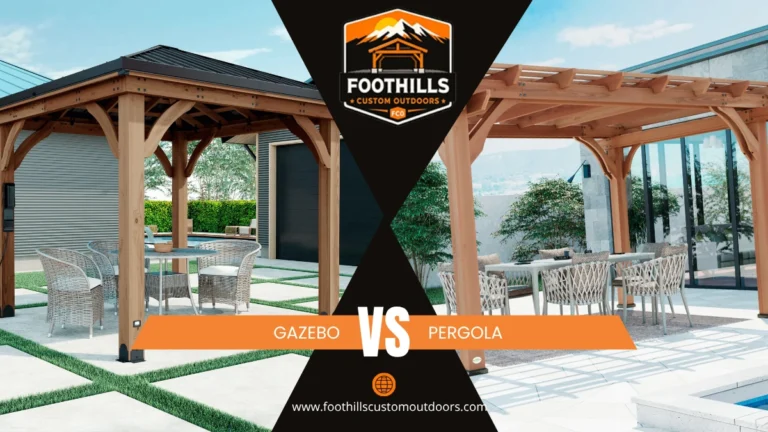
More context on how Foothills approaches outdoor structure projects generally, and what our authorized dealer relationship means for warranty support, is covered on the about and why choose Foothills page. And if you are still working through the pergola-versus-gazebo decision before you get to the contractor vetting stage, the comparison guide for Knoxville backyards walks through the trade-offs at length.
Frequently Asked Questions
How do I verify a pergola contractor’s insurance in Tennessee?
Request the certificate of insurance (COI) from the contractor, which lists the insurance carrier, policy number, coverage amounts, and expiration date. Call the insurance carrier directly using a phone number you look up independently (not one the contractor provides) and confirm the policy is current, that the contractor is the named insured, and that coverage amounts match the certificate. Most legitimate contractors can provide a COI within 24 to 48 hours; delays or excuses are a warning sign.
Do pergola contractors in Knoxville need a state contractor’s license?
Depends on project size. Tennessee state contractor’s license requirements apply above certain project thresholds (verify the current threshold with the Tennessee Department of Commerce and Insurance Contractors Licensing Board). Smaller pergola projects may fall below the threshold. Regardless of state licensing, local business permits and insurance coverage are still required for legitimate operation.
What is a reasonable deposit for a pergola contractor to require?
Industry standard in the Knoxville pergola market is 25 to 40 percent at contract signing, with progress payments at defined milestones and final payment at completion. Deposits above 50 percent are outside industry norms and shift risk unfavorably to the homeowner. Contractors demanding full payment upfront are a significant red flag.
How many pergola contractor quotes should I get before deciding?
Three quotes is the typical recommendation and works well for most projects. Two quotes provides some comparison but may not reveal outliers on either the high or low end. More than four quotes rarely surfaces new information but adds to your time investment.
How long is a pergola contractor quote typically valid for?
30 days is standard for most Knoxville-area pergola quotes. Some contractors hold quotes for 45 to 60 days; others tie validity to specific material pricing that may fluctuate. Confirm the validity period in writing. Contractors who insist on same-day signing under threat of price increases are using pressure tactics rather than professional pricing.
What questions should I ask before hiring a pergola installer?
The full 15-question script in the section above works for any pergola installer interview. If you have to prioritize, the five most-important questions are: 1) Are you licensed and insured, and can you provide documentation? 2) Do you do the work yourself or subcontract? 3) Can you provide three recent local references? 4) What foundation and anchoring approach are you specifying for my site? 5) What workmanship warranty do you offer, and how are claims handled?
How do I know if a pergola company is reliable?
Reliability shows up in five verifiable places: current business registration in Tennessee, verifiable insurance coverage with a legitimate carrier, positive references from recent local projects, transparent written quotes with itemized scope, and a documented workmanship warranty. Contractors reliable on all five metrics are the contractors you want. Contractors weak on any of these five are contractors you should think twice about.
What should be included in a pergola installation quote?
Complete quote should include: pergola product specification (make, model, size, material, finish), all labor components itemized (delivery, site prep, foundation, assembly, anchoring, finish, cleanup), permit fees and coordination, warranty terms (product and workmanship separately), total price with tax, payment schedule, timeline, weather contingency policy, and any add-ons priced separately. Missing items reveal gaps in the contractor’s process or intentional under-scoping.
Should I choose the cheapest quote for a pergola?
Rarely. If the cheapest quote is 30 percent or more below the other quotes for the same scope, something is being excluded, cut, or misunderstood. The most common reasons for meaningfully low quotes: skipped foundation work, skipped permits, ground anchors instead of concrete footers, cheaper product than specified, or a contractor without insurance. Any of those saves money in the short term and costs money in the long term.
How long does it take to get a pergola contractor quote?
For a straightforward project on an accessible site, most Knoxville-area contractors can produce an itemized quote within 3 to 7 business days of the initial site visit. Complex projects, custom designs, or sites requiring meaningful evaluation can extend to 10 to 14 days. Contractors who quote instantly without a site visit are quoting without adequate information; contractors who take more than three weeks may be signaling scheduling problems.
What if I have already signed a contract and now see red flags?
Review the contract’s cancellation policy immediately. Most reputable contractors include a right-to-cancel window (often 3 business days) that lets you back out with limited or no penalty. If you are past the cancellation window and the red flags are serious (insurance issues, licensing problems, criminal history), consult a construction attorney about your options. Documented issues with the contractor may support cancellation even outside the standard window.
Do I need to be home while my pergola is being installed?
An adult 18 or older with authority to make placement decisions should be present for at least the initial walkthrough at arrival, any mid-day decisions that come up, and the final walkthrough at completion. That does not necessarily mean the same person needs to be onsite for the full duration; it means someone with authority needs to be reachable and available at those key moments.
Should I hire a general contractor or a specialty pergola installer?
Depends on your project. For a standalone pergola on an existing patio, a specialty pergola installer is often the right choice: focused expertise, faster scheduling, better pricing than a full-service GC on this specific scope. For a pergola integrated with broader outdoor living work (kitchen, patio, lighting, landscape), a general contractor or full-service outdoor living builder who can coordinate the whole project often delivers better results than stitching together three separate contractors yourself.
Making the Final Decision
The right pergola contractor for your Knoxville-area project is not necessarily the cheapest, not necessarily the most expensive, and not necessarily the one with the flashiest website. It is the contractor who answers the 15 essential questions with substance, provides transparent itemized quotes, verifies cleanly on insurance and licensing, delivers strong local references, and documents warranty terms in writing.
Take the time to work through the vetting checklist. Get three quotes. Ask the reference-check questions that actually surface useful information. Compare quotes apples-to-apples on identical scope. Work through the 20-item pre-contract checklist before signing. The hour or two of homework this takes is the cheapest insurance available on a project that will stand in your yard for 20 years.
A well-built pergola installed by the right contractor is a permanent addition to your outdoor space. A poorly built pergola installed by the wrong contractor is a slow-motion problem that shows up in year two and gets worse from there. The contractor selection is the decision that determines which outcome you get.